It’s 7:14 in the morning.
Your alarm just went off. You haven’t even sat up in bed yet, but your chest already feels tight. Your mind is already running through the 47 things you didn’t finish yesterday. You’re exhausted before the day has even started.
By 10am, you’re reaching for something sweet. By 2pm, you’re crashing. By midnight, you’re wide awake and staring at the ceiling — too tired to move, too wired to sleep.
Sound familiar?
If it does, I want you to know something important: this isn’t a character flaw. This isn’t laziness. This is a hormone problem.
That hormone has a name: cortisol. And you don’t know why your cortisol is out of control.
Here’s what I know from over a decade of life coaching at Self Help Powers — almost every client I’ve worked with who described feeling “stuck,” exhausted, anxious, and like their body was fighting against them… had one thing in common. Their stress hormone was working overtime. It was running at full blast, day after day, with no off switch.
According to Gallup’s Global Emotions Report, nearly 49% of Americans experience significant daily stress — one of the highest rates among high-income nations in the world. That’s almost 1 in every 2 adults walking through life with a constant undercurrent of tension they can’t shake.
We are living through a cortisol crisis. And in this article, I’m going to help you understand exactly what’s happening inside your body — and what you can actually do to fix it.
What Is Cortisol — And Why Does Your Body Even Make It?
Before we talk about what goes wrong, let’s talk about what goes right.
Cortisol is a hormone made by your adrenal glands — two small glands that sit right on top of your kidneys. It’s often called “the stress hormone,” but that nickname makes it sound like the villain. It’s not. In fact, your body genuinely needs cortisol to function.
Cortisol helps you wake up in the morning. It regulates your blood sugar. It manages inflammation. It gives you a burst of energy when you need it most. In short bursts, it’s lifesaving.
Think about it this way. Imagine you’re being chased by a lion. (I know — bear with me.) Your brain sounds the alarm. Your adrenal glands release a flood of cortisol. Your heart beats faster. Blood sugar rises. Your muscles get a hit of quick energy. Your body is in full survival mode. That’s cortisol doing its job perfectly.
The system that triggers this is called the hypothalamic-pituitary-adrenal (HPA) axis — a chain of signals between your brain and your adrenal glands. It’s your body’s built-in alarm system.
Here’s the catch though.
“The problem isn’t cortisol,” I always tell my clients. “The problem is a world that never turns the alarm off.”
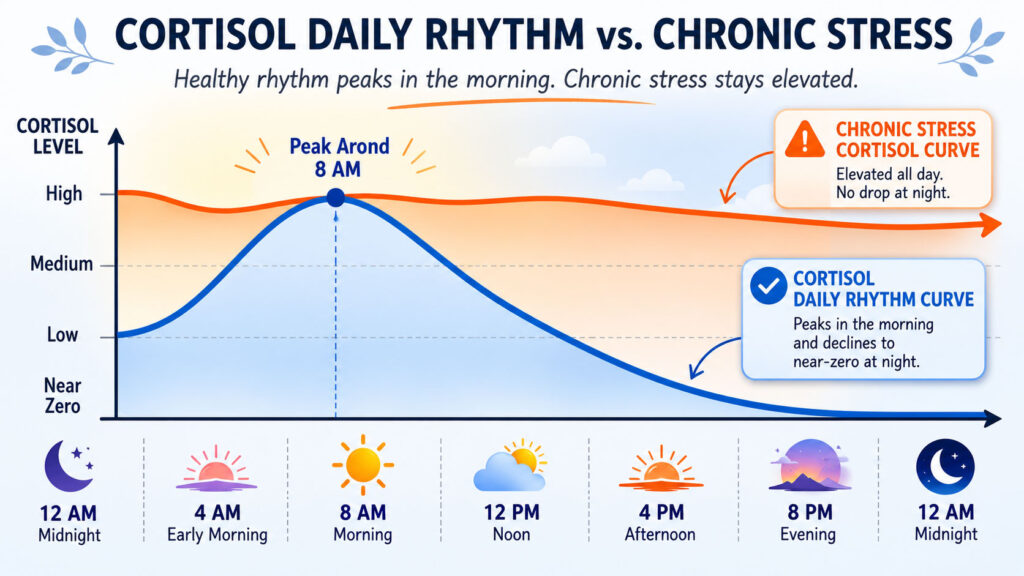
Cortisol is meant to spike and then drop. In a healthy body, it peaks in the morning, helps you get going, and then tapers off through the day so you can rest at night. But when stress is constant — when the threats never stop — that alarm stays on. And when the alarm stays on, everything starts to break down.
What Is Causing the Cortisol Crisis? Why Is Everyone’s Cortisol Out of Control Right Now?
Let me be direct with you: modern life is one long cortisol trigger.
Think about what we’re dealing with every single day. Work emails at 10pm. Financial anxiety. Political uncertainty. Social media feeds designed to keep us alarmed and scrolling. The pressure to be productive, successful, healthy, and happy — all at once. Never truly clocking off.
And the numbers back this up hard.
Research from the American Psychological Association found that 54% of U.S. workers say job insecurity has a significant impact on their stress levels right now. According to recent workplace burnout research, Gen Z and millennials are now hitting peak burnout at just 25 years old — a full 17 years earlier than previous generations.
Think about that. Twenty-five years old and already burned out.
Here’s the part that really gets me, though: your brain cannot tell the difference between a physical threat — like that lion — and an emotional one. A tense Slack message from your boss triggers the same cortisol spike as a genuine physical danger. Your brain doesn’t care that it’s “just” an email. It sounds the alarm either way.
So you’re walking around in a near-constant state of biological emergency. And your cortisol is paying the price.
I had a client — let’s call her Meera — who came to me after gaining 18 pounds in a year. She was exercising five days a week. She was eating “clean.” Nothing was working. When we started talking, it became clear she was sleeping 5 hours a night, saying yes to every work request, and had zero downtime. Her body wasn’t failing her. Her cortisol was through the roof.
This is not uncommon. This is happening to millions of people right now. And the first step to fixing it is knowing what to look for.
ALSO READ: What Is Emotional Flooding and How Do You Stop It?
What Are the Warning Signs That Your Cortisol Is Too High?
This is one of the most important sections of this article. Because so many people I talk to at Self Help Powers are living with high cortisol and they don’t even know it. They just think this is what life feels like.
It’s not. Here’s what elevated cortisol actually looks like:
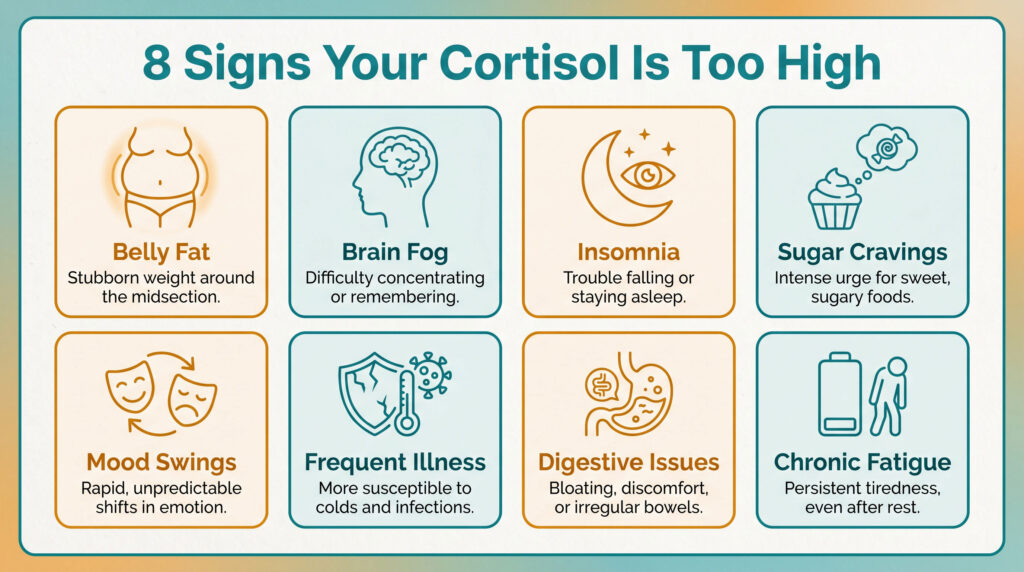
Belly fat that won’t budge. You’re doing everything right, but the weight keeps collecting around your midsection. This is one of cortisol’s most frustrating calling cards. High cortisol levels are closely linked to the buildup of visceral fat — the dangerous deep-belly fat that wraps around your organs.
Brain fog and memory slips. You forget words mid-sentence. You walk into rooms and forget why. You can’t concentrate. Chronic cortisol exposure can cause actual structural damage to the hippocampus — the brain region responsible for memory and learning.
Wired but tired. You’re exhausted all day, but the moment your head hits the pillow, your mind starts racing. This is the cortisol-insomnia loop, and it’s brutal.
Cravings for sugar and salt. Your body, under stress, craves fast energy. Cortisol directly increases appetite and makes high-calorie “comfort foods” feel more rewarding than they normally would.
Mood swings and anxiety. Feeling irritable for no clear reason? Snapping at people you love? Elevated or dysregulated cortisol is directly linked to anxiety, depression, and emotional instability.
Getting sick more often. Cortisol suppresses your immune system. If you’re catching every cold that goes around, chronic stress may be the reason.
Digestive problems. Bloating, indigestion, irregular digestion — cortisol shuts down your gut function when it thinks you’re in danger.
Exhaustion that sleep doesn’t fix. You sleep 8 hours and wake up still tired. This is adrenal fatigue territory.
If you’re nodding along to 3 or more of these — please keep reading. Because we’re going to talk about what to do about every single one.
What Does High Cortisol Do to Your Brain and Body Over Time?
Here’s where I want to be really honest with you. Because this isn’t just about feeling tired or gaining a few pounds. Long-term high cortisol is genuinely dangerous.
According to the Mayo Clinic, prolonged exposure to cortisol puts you at higher risk for heart disease, heart attack, high blood pressure, stroke, diabetes, digestive problems, depression, and serious memory and focus issues. That’s not a short list.
Let’s break down the biggest ones.
Your brain literally shrinks. I don’t say that to scare you — I say it because it’s important. Research shows that chronic cortisol exposure causes atrophy in the hippocampus and the prefrontal cortex — the parts of your brain responsible for memory, decision-making, and emotional regulation. That’s why long-term stress doesn’t just feel awful. It actually changes how your brain works.
Your heart takes a hit. High cortisol keeps blood pressure elevated. Over months and years, that puts enormous strain on your cardiovascular system.
Your belly gets bigger. Cortisol promotes the storage of visceral fat — the deep abdominal fat that’s linked to metabolic syndrome, insulin resistance, and type 2 diabetes. This is why “cortisol belly” has become such a widely recognized phrase.
Your immune system gives up. Chronic stress leads to immune dysregulation — meaning your body gets worse at fighting infections, inflammation, and even autoimmune conditions.
Your mental health suffers. Dysregulated cortisol is directly linked to major depressive disorder, anxiety disorders, and bipolar disorder. It’s not a coincidence that so many people dealing with chronic stress also battle depression and anxiety. These things are biologically connected.
I watched a client of mine — a high-achieving woman in her early 40s — go from sharp and energized to barely functional in under two years. She was dismissed by multiple doctors. Everyone told her she was “just stressed.” It wasn’t until we connected the dots — the sleep deprivation, the relentless work pressure, the cortisol cascade — that she started making real progress.
Her story is not rare. This is happening in living rooms and offices everywhere right now.
ALSO READ: Overwhelmed vs Overstimulated: What’s the Difference and Why It Matters
How Can You Lower Your Cortisol Naturally? (Here’s the Real Fix)
Now for the part I love most — because this is where you take your power back.
The good news is that stress-related cortisol elevation is reversible. You don’t need a prescription. You don’t need a complete life overhaul. You need consistent, targeted habits that tell your nervous system it’s safe to stand down.
Here are the most effective, science-backed strategies I recommend at Self Help Powers:
Can Better Sleep Actually Reset Your Cortisol?
Yes — and it might be the single most powerful thing you can do.
Cortisol follows a natural daily rhythm. It rises in the morning to help you wake up and falls at night so your body can repair itself. Poor sleep shatters this rhythm. When sleep is disrupted, cortisol stays elevated into the evening — the exact opposite of what your body needs.
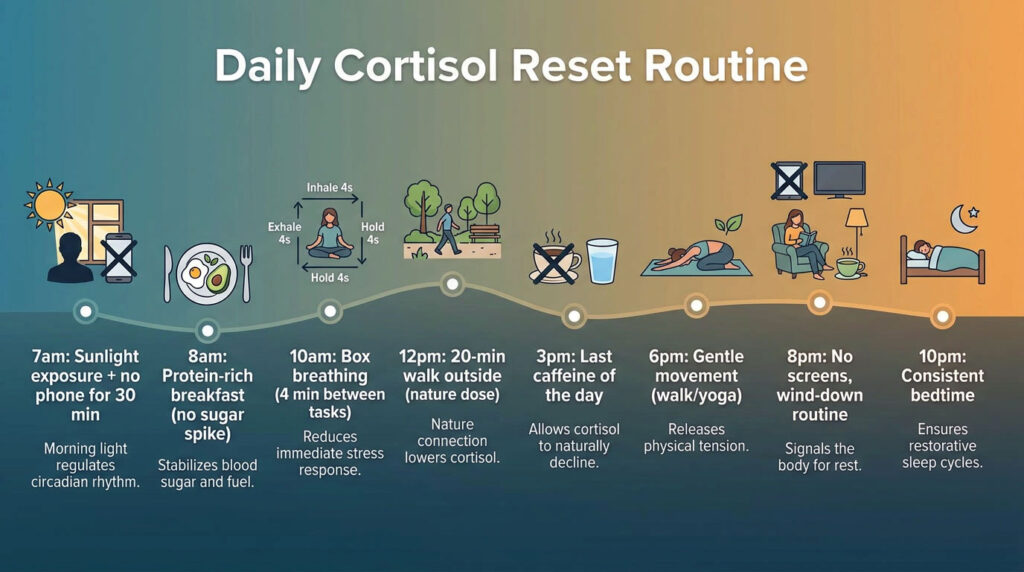
Aim for 7–9 hours. Go to bed at the same time every night. Keep your room cool and dark. Cut off screens an hour before bed. This isn’t just good hygiene — it’s hormone medicine.
“Sleep is not a luxury,” I tell every single one of my coaching clients. “It is the foundation that every other healthy habit is built on. You cannot think your way out of a cortisol problem if you’re sleeping 5 hours a night.”
Does Exercise Lower Cortisol — or Make It Worse?
Both. And the difference matters.
Intense or excessive exercise actually raises cortisol in the short term. If you’re already burned out and you’re doing brutal high-intensity workouts every day trying to lose weight — you may actually be making your cortisol worse.
The sweet spot is moderate movement. Brisk walking, swimming, yoga, cycling, light strength training. These activities reduce cortisol over time without sending your nervous system into another panic.
Thirty minutes a day at a moderate intensity is your target. Enjoyment matters too — if you dread it, you won’t do it, and the dread itself is a cortisol trigger.
Can Spending Time in Nature Actually Lower Your Cortisol?
Absolutely — and the science on this is striking.
A 2019 study found that spending just 20 to 30 minutes in nature, at least three times a week, was one of the most effective ways to reduce cortisol levels. Parks, forests, beaches, even green spaces near your home all count.
Your brain evolved over millions of years in natural environments. The built environment — screens, notifications, artificial lighting — is deeply foreign to your nervous system. Nature tells your brain, at a very deep level, that you are safe.
Take your lunch break outside. Go for a walk without your phone. Even 20 minutes in a park can begin to bring those cortisol levels down.
Does Mindfulness and Breathwork Really Work — or Is It Just a Trend?
It works. Full stop.
Mindfulness meditation has been shown to lower cortisol by improving the body’s ability to stay calm under stress. It also strengthens emotional regulation — so stressful events don’t knock you as far off balance.
You don’t need to meditate for an hour. Start with 10 minutes a day. Apps like Headspace, Calm, or Insight Timer make this accessible for beginners.
One breathwork technique I personally swear by — and teach regularly — is box breathing: breathe in for 4 counts, hold for 4, out for 4, hold for 4. Repeat for 5 minutes. Deep breathing directly activates the parasympathetic nervous system — your body’s “rest and digest” mode — which physically counteracts the cortisol response.
Do this before a stressful meeting. Do it when you wake up anxious at 3am. It works because it’s not just a coping trick — it’s a biological override.
What Foods Help Lower Cortisol — and What Makes It Worse?
Your diet has a more powerful impact on your cortisol than most people realize.
Foods that help:
Fatty fish like salmon, mackerel, and sardines are rich in omega-3 fatty acids, which have been shown to reduce cortisol and adrenaline spikes during stress. Aim for 2–3 servings a week.
Dark chocolate — 70% cacao or higher — contains polyphenols that reduce inflammation and help lower cortisol. A Swiss study found that 40g of dark chocolate daily reduced cortisol levels in anxious individuals within two weeks. (Yes, this is real science, and yes, it’s wonderful news.)
Leafy greens, avocados, and pumpkin seeds are rich in magnesium — a mineral your body burns through rapidly under stress. Low magnesium is directly linked to elevated cortisol.
Fermented foods — kimchi, kefir, yogurt, sauerkraut — support a healthy gut microbiome. A 2024 meta-analysis of 46 studies found that probiotic supplementation significantly decreased cortisol levels.
Foods that hurt:
Refined sugar spikes your blood sugar, which triggers cortisol. Ultra-processed foods, excessive caffeine, and alcohol all amplify the cortisol response. Caffeine in particular — especially consumed when you’re already stressed or before exercise — can meaningfully elevate cortisol secretion.
Does Social Connection Actually Affect Cortisol Levels?
More than you might think.
Loneliness is one of the most powerful cortisol triggers there is. Social support and meaningful connection have been shown to reduce HPA axis activation — meaning your body releases less cortisol when you feel safe and connected to others.
Call a friend. Have dinner with people you love. Spend less time in online environments that make you feel judged or anxious, and more time in real relationships that make you feel seen.
At Self Help Powers, we talk a lot about the fact that human beings are wired for community. Isolation is not just emotionally painful — it’s physiologically costly.
Can Adaptogens Like Ashwagandha Actually Help?
There’s real science here, but with nuance.
Ashwagandha is the most well-researched adaptogen for cortisol. Multiple human trials have shown it can help reduce stress hormone levels. L-theanine — found in green tea — has also been shown to blunt cortisol spikes during acute stress.
If you’re considering adaptogens, speak to your doctor first, especially if you’re on other medications. They’re not a replacement for the lifestyle changes above — think of them as a supporting tool, not a solution on their own.
When Should You Actually See a Doctor About Cortisol?
For most people reading this, high cortisol is lifestyle-driven — and lifestyle-fixable. But there are cases where cortisol elevation has a medical cause that needs professional attention.
See a doctor if you notice: very rapid weight gain concentrated in the abdomen, face, and back of the neck (sometimes called a “buffalo hump”); easy bruising; purple stretch marks on the abdomen; significant muscle weakness; or extreme mood changes that seem out of proportion.
These can be signs of Cushing’s syndrome — a serious medical condition caused by chronically extreme cortisol levels, often due to a tumor in the pituitary or adrenal glands. It’s rare, but it’s real, and it’s treatable.
For everyday chronic stress cortisol — which is what most of us are dealing with — testing isn’t usually needed. But if you want to check, a late-night salivary cortisol test, a 24-hour urine cortisol test, or a morning blood cortisol test can all give useful information. Ask your doctor if you’re concerned.
So, Is Your Cortisol Out of Control — and What Do You Do Now?
Here’s my honest answer after working with hundreds of people through Self Help Powers: yes, if you’ve recognized yourself in this article, your cortisol is very likely elevated. And no — it’s not your fault. You’re living in a world that is relentlessly, by design, triggering your stress response.
But here is also the truth: you are not powerless.
The strategies in this article are not complicated. They are not expensive. They are not reserved for people with more time or more willpower than you. They are available to you today, in small doses, one step at a time.
Start with sleep. Then add 20 minutes outdoors. Then try the box breathing. Pick one thing and do it consistently for a week.
Your nervous system is not broken. It’s been doing exactly what it was designed to do — protecting you. It just needs you to send the signal that the danger has passed.
You can do that. I’ve watched people do it over and over again. And the transformation that comes from rebalancing this one hormone — more energy, clearer thinking, better mood, deeper sleep, a body that finally feels like yours again — it is absolutely worth the effort.
Come back to Self Help Powers whenever you need support, resources, or a reminder that the tools you need to feel better are already within reach.
Frequently Asked Questions (FAQs)
How do I know if my cortisol is high without getting a test?
Look at the symptoms: unexplained belly fat, brain fog, poor sleep despite being exhausted, sugar cravings, frequent mood swings, and catching every illness going around. If 3 or more of these feel familiar and persistent, elevated cortisol is a very likely factor. A doctor can confirm with a simple salivary or blood test if needed.
Can stress cause weight gain even if I’m eating healthy and exercising?
Yes — and this is one of the most frustrating realities of cortisol. High cortisol increases appetite, triggers cravings for high-calorie foods, promotes visceral fat storage, and slows metabolism. Even a clean diet and regular exercise can be undermined by chronically high cortisol. Stress management is not optional when it comes to weight — it’s essential.
Does cortisol affect sleep, or does poor sleep raise cortisol?
Both — and that’s what makes it such a vicious cycle. High cortisol disrupts sleep by keeping your body in a state of alert. And poor sleep prevents cortisol from dropping overnight, keeping levels elevated the next day. The best way to break the loop is to prioritize sleep consistency above all else — same bedtime, same wake time, every day.
How long does it take to lower cortisol naturally?
Most people begin to notice real improvements — better sleep, less anxiety, more stable energy — within 2 to 4 weeks of consistent lifestyle changes. Full hormonal rebalancing can take 2 to 3 months. The key word is consistent. Small daily habits compound powerfully over time.
Is ashwagandha safe for lowering cortisol?
For most healthy adults, ashwagandha is considered safe and has solid clinical research behind it for cortisol reduction. However, it’s not suitable for everyone — including pregnant women, people on thyroid medication, or those with autoimmune conditions. Always consult your doctor before starting any supplement, even a natural one.
Author
-
 Lisa Arien is a and lead writer at Self-Help Powers, where she merges her with real-world experience to help readers achieve lasting personal growth. Known for her ability to simplify complex psychological concepts, Lisa empowers individuals to turn self-awareness into action. Her insights have been featured in , establishing her as a trusted guide in the field of self-improvement.