You’re in the middle of a conversation — maybe with your partner, your boss, your child, or even just yourself in a moment of overwhelming stress — and something shifts.
Your heart starts hammering. Your thoughts go foggy and scattered. Your chest tightens. The words you need simply won’t come. You can feel that you’ve lost the thread of reason, but you can’t grab it back no matter how hard you try.
And then later, when the storm passes, you think: “Why did I react like that? That wasn’t me.”
But here’s what I need to tell you before we go any further: it was you. But it wasn’t the version of you that was in control.
In those moments, something very specific and very real happened inside your brain. Your emotional alarm system fired — fast, loud, and without asking your permission — and your rational thinking mind got temporarily knocked offline. You weren’t being dramatic. You weren’t being weak. You weren’t “too emotional.”
You were flooded.
And flooding is not a character flaw. It is a physiological event — one that happens to every human being on earth, with roots stretching back millions of years in our evolutionary history.
I’ve been a life coach for over a decade. I’ve sat with hundreds of people across that table, and I can tell you: the shame that people carry after an episode of emotional flooding is often heavier and more damaging than the flooding itself. They describe it as losing themselves. As becoming someone they don’t recognize. As failing — at communication, at relationships, at emotional control.
They’re not failing. They’re flooding. And there is a profound difference.
By the end of this post, you’ll understand exactly what emotional flooding is, why it happens in YOUR specific brain and nervous system, how to stop it when it’s happening, and how to build a life where it happens less often. This is one of the most important things you can learn about yourself.
At Self Help Powers, this is the kind of deep, grounded self-understanding we’re built around — because knowing your own mind is the foundation of everything else.
Exactly, What Is Emotional Flooding — And Why Does It Feel Like Losing Control?
Psychologist John Gottman first coined the term “emotional flooding” in the 1990s while researching couple dynamics and conflict. According to Gottman’s research, flooding is the experience of becoming so overwhelmed by emotion that your thinking brain — the part that can weigh nuance, hold multiple perspectives, and communicate clearly — effectively shuts down.
Here’s a metaphor I love for explaining this to my clients:
Imagine your mind is a filing cabinet. Every emotion you’ve experienced, every unresolved conflict, every old wound — it’s all in there, in separate folders, neatly categorized. Most of the time, you can find what you need. You pull a drawer, select the right file, handle the situation.
But emotional flooding is like someone sneaking up behind you and knocking the entire cabinet over — all at once. Every drawer flies open. Every folder spills out. You’re standing in a snowstorm of your own emotional contents, and none of it is organized, and none of it makes sense, and there is no way to find the right file in this moment because they’re all on the floor.
That is flooding. Not too much emotion — but emotion arriving all at once, faster than your mind can process or sort it.
As Psychology Today explains, the difference between flooding and more manageable emotional experiences is one of intensity. Flooding happens quickly — often out of the blue — and it always overwhelms your sense of safety, even if you’re not truly in danger.
And here is the most important thing to understand about it: flooding is not exclusive to people with mental health conditions, trauma histories, or anger problems. It can happen to anyone. At any time. Given the right trigger, the right level of accumulated stress, and the right moment of vulnerability — your otherwise rational, capable mind can go offline in seconds.
That’s not a personal failing. That’s biology.

What Is Actually Happening in Your Brain When You Get Emotionally Flooded?
This is the part that changes everything. Because once you understand what’s physically happening inside your brain during a flood, it stops feeling like a mystery — and starts feeling manageable.
Let’s meet the two key players.
The amygdala is a small, almond-shaped structure deep in the brain’s limbic system. Think of it as your brain’s smoke detector — its entire job is to scan your environment for threats and trigger an alarm when it finds one. It does this incredibly fast. Neuroscience research shows that the amygdala processes threat-related stimuli in as little as 12 milliseconds — before your conscious mind has any awareness that something is happening.
The prefrontal cortex is the large front portion of your brain — the part that makes you distinctly human. This is the seat of rational thought, empathy, communication, decision-making, and emotional nuance. When your prefrontal cortex is online, you can listen, you can consider, you can choose your words, you can understand another person’s perspective.
Here’s the problem: in a state of perceived threat, the amygdala fires so fast that it triggers the body’s stress response — cortisol and adrenaline flood the system — before the prefrontal cortex has had any chance to evaluate whether the threat is actually real.
Psychologist Daniel Goleman called this the “amygdala hijack” — and it’s a perfect name. The amygdala literally hijacks your brain, routing control away from the rational mind and toward survival mode. Your heart pounds. Your breathing shallows. Your muscles tense. Blood flows to your limbs — your body is preparing to fight, flee, or freeze.
And your prefrontal cortex? It goes quiet. Temporarily offline. Taking with it your ability to reason, to empathize, to communicate clearly, to see the situation accurately, and to make good decisions.
As the Wildflower Center for Emotional Health explains, our brain has simply not evolved enough to tell the difference between real danger and perceived emotional danger. This is why you can experience full-blown flooding during an argument about dishes, a criticism from your boss, or a message that hits a deep nerve — your amygdala doesn’t know these situations aren’t life-threatening. It just knows it detected a threat. And it reacted accordingly.
This is your brain doing exactly what it was designed to do. It’s just doing it at the wrong time.
What Does Emotional Flooding Feel Like? The Signs You Might Be Missing
Flooding doesn’t always announce itself with a dramatic explosion. In fact, some of the most powerful episodes of flooding look quiet on the outside — a person who goes completely cold and silent, who can’t find words, who withdraws entirely — while a storm is raging internally.
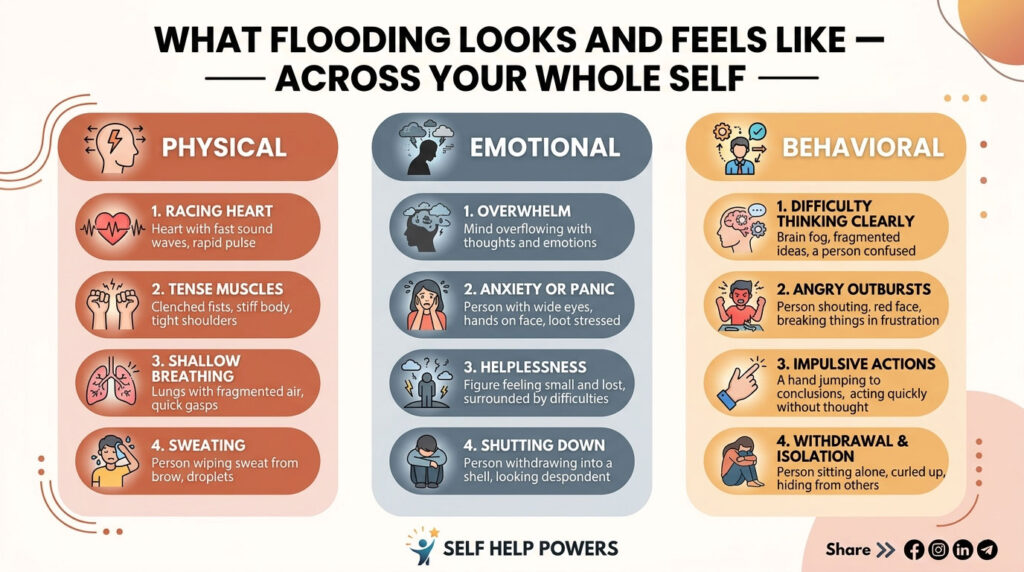
Here are the signs, across all three dimensions:
What Are the Physical Signs of Emotional Flooding?
Your body always knows before your mind does. Watch for:
- A racing or pounding heart — sometimes so loud it’s hard to concentrate
- Shallow, tight breathing or a sudden inability to take a full breath
- Tightness in the chest or throat — the feeling of being “choked up” even when you don’t want to cry
- Flushing in the face, sweating, or a hot sensation spreading through the body
- Shaking hands, wobbly legs, or a feeling of physical unsteadiness
- Tunnel vision — the room narrows, peripheral detail disappears, everything feels both heightened and blurred
According to the Inspira Health Center, physical symptoms during flooding are caused directly by the rush of stress hormones — these are the same signals your ancestors used to outrun predators, now activated by an email, an accusation, or a feeling of being dismissed.
What Are the Emotional and Mental Signs of Emotional Flooding?
- You can’t think straight. A question feels unanswerable. Simple words evade you.
- Everything feels urgent and catastrophic — like this moment is the worst thing that has ever happened and will define everything.
- You lose perspective entirely on the actual size of the problem.
- You feel like you’re watching yourself from outside — dissociated, unreal.
- You oscillate rapidly between different emotions — anger to embarrassment to fear and back — without being able to name what you’re actually feeling.
- Your memory becomes unreliable — you may not clearly remember what was said moments ago.
What Are the Behavioral Signs of Emotional Flooding?
This is where flooding becomes visible to the people around you:
Stonewalling — you shut down completely. You stop responding. You go quiet and closed. This isn’t a choice — it’s the brain’s “freeze” response at work. You are not being cold deliberately. You literally cannot access the words.
Exploding — the opposite end. Words come, but unfiltered. You say things you immediately regret. Volume and emotion spike. Afterward, you wonder who was speaking.
Fleeing — physically leaving the room, the conversation, the situation. Or emotionally leaving — going “away” inside yourself while your body remains present.
Replaying — you calm down, leave, and then spend hours mentally rehearsing the conversation, what you should have said, what they really meant, what this means for the relationship. This is the aftermath of flooding, and it keeps the nervous system activated long after the event.
I always ask my clients: which way do you go when you flood? Do you go loud or go quiet? Do you leave or do you freeze? There’s no wrong answer — but knowing your pattern is everything. Because when you know how you flood, you can catch yourself earlier.
Who Gets Emotionally Flooded More — And Why?
Everyone experiences emotional flooding. It’s a feature of being human, not a flaw in some people’s wiring.
But your threshold — the point at which your nervous system tips from regulated into flooded — varies significantly based on factors that are deeply personal.
Highly sensitive people (HSPs) have nervous systems that are literally wired to process stimulation more deeply. As research on the highly sensitive brain confirms, HSPs experience emotions more vividly, pick up on subtle cues that others miss, and have a lower threshold for overwhelm. This is not a weakness — it’s a different calibration. But it does mean flooding can happen faster, more intensely, and from triggers that seem minor to someone else.
Trauma survivors have amygdalae that have been sensitized by past experience. As neuroscience explains it, when we experience something frightening or deeply painful, our brain encodes the sensory details — a tone of voice, a particular look, a phrase, a physical sensation — and files them under “threat.” From then on, anything that resembles those details can trigger the alarm system, even in situations that are entirely safe. The past literally lives in the nervous system.
People with anxious attachment styles carry a persistent, low-level fear of rejection, abandonment, or not being enough. When something in a relationship touches that fear — a perceived criticism, a moment of distance, a tone that “sounds off” — the attachment alarm fires, and flooding follows. Research published in peer-reviewed journals confirms that flooding is significantly more common in distressed relationship patterns and is associated with attachment insecurity.
People with ADHD often have challenges with emotional regulation and impulse control that make flooding more frequent and more intense. The ADHD brain can have a hair-trigger emotional response that bypasses the slower, moderating influence of the prefrontal cortex.
Burned-out people are among the most flooding-prone populations — and this is the link I want to draw clearly for readers of Self Help Powers. When your nervous system has been under chronic stress for a prolonged period — as it is in burnout — it is constantly primed. The “window of tolerance” (the range within which your nervous system can handle stress without flooding or shutting down) becomes narrower and narrower. Triggers that you could once absorb easily become overwhelming. Small things feel enormous. This is not you getting weaker — this is your nervous system running out of reserve capacity.
Gender and cultural conditioning also play a role. Men are often socialized from childhood to suppress emotional expression — which doesn’t eliminate emotion, it just drives it underground. When suppressed emotions finally break through, they tend to arrive with more force and less regulation. Gottman’s research found that men were more likely to flood and required less intense partner negative affect to withdraw or stonewall — a pattern shaped significantly by how emotions are taught and permitted in boyhood.
I worked with a man who described himself as ‘not emotional at all.’ He was wrong. He was a highly emotional person who had spent 40 years learning to push emotion down. The flooding that came out in his marriage wasn’t him being emotional — it was 40 years of suppression meeting a safe enough relationship to finally break through.
What Triggers Emotional Flooding Most Often?
Triggers are personal. But certain categories show up again and again across research and in my work with clients.
Relationship conflict — by far the most common and most studied trigger. According to Psychology Today, how a discussion begins often predicts its outcome. Gottman calls this the “harsh startup” — when a conversation opens with criticism, blame, or contempt, the recipient may immediately flood, making any productive conversation impossible before it’s even begun.
Feeling unheard, dismissed, or misunderstood. Few things activate the threat response faster than the feeling that we are not seen or that our experience is being minimized. “You’re overreacting” is, for many people, the single most flooding-inducing sentence in the English language.
Criticism and contempt. There is a difference between feedback and contempt — and the amygdala knows the difference. Contempt communicates “I don’t respect you,” and the emotional system treats that as a profound threat to safety and belonging.
Trauma echoes — when a present moment activates a past wound. Your partner uses a tone of voice that matches your critical parent. A coworker dismisses you the same way a teacher once did. A situation echoes an old feeling of powerlessness. Your nervous system responds to the past, not the present — and you flood as if the old threat is happening right now.
Physical depletion. This one is chronically underestimated. When you are sleep-deprived, hungry, ill, or physically exhausted, your prefrontal cortex is already running at reduced capacity. Your window of tolerance narrows dramatically. Things that would barely register on a rested day become genuinely overwhelming. This is why difficult conversations should never happen when one person is hungry, exhausted, or sick — the brain simply isn’t equipped to handle them without flooding.
Accumulated stress without recovery. This is the burnout-flooding link in its purest form. Stress is not the problem — stress without adequate recovery is. Each unprocessed stressor adds weight to the load. After enough accumulation, almost anything can tip the scales.

How Do You Stop Emotional Flooding In the Moment?
This is the section people search for most. And I want to be honest with you before we dive in: you cannot think your way out of an emotional flood. The rational mind is offline. Logic is not available. Telling yourself to “calm down” or “be reasonable” is like trying to install software while the power is out.
What you can do is work with your body — because your body is what’s flooded, and your body is where the reset happens.
What Is the Gottman 20-Minute Rule — and Does It Actually Work?
John Gottman’s research established that the average person needs a minimum of 20 minutes for the body to physiologically reset after becoming emotionally flooded — and that reset only works if you use that time to genuinely self-soothe, not to continue replaying the conflict in your head.
Most people take a “break” from an argument by continuing the argument internally — planning their next response, building their case, rehearsing everything the other person did wrong. This keeps the stress hormones circulating. The body never receives the signal that the threat has passed. Twenty minutes passes, and you return to the conversation just as flooded as when you left.
Real self-soothing means doing something — a walk, a breathing exercise, music, nature, physical movement — that shifts your physiological state. Something that signals to your nervous system: we are safe. The threat has passed. You can stand down.
The 20-minute rule works. But only if you actually use the 20 minutes.
What Grounding Techniques Actually Help When You’re Flooded?
Here are five techniques backed by neuroscience — practical, accessible, and designed to work when rational thinking is unavailable.
Technique 1 — The Orienting Response
Research shows that slowly looking around the room and naming objects you see — five of them, taking your time — sends a powerful safety signal to your amygdala. When you orient to your environment, your brain registers: I can see the room. I am not in danger. The threat is not physical. Move your head and eyes gently. Let your gaze land on specific objects. Name them quietly or aloud.
This is not a distraction technique. It is a direct neurological interrupt.
Technique 2 — Extended Exhale Breathing
The key that most breathing advice gets wrong: it’s not the inhale that calms you — it’s the exhale. Neuroscience confirms that elongating the exhale activates the parasympathetic nervous system — your body’s “rest and recover” mode — which directly counteracts the fight-or-flight response.
Try this: inhale for 4 counts, exhale for 6 to 8 counts. The exhale should be noticeably longer than the inhale. After three rounds, your heart rate begins to drop and cognitive function starts to return.
Technique 3 — Affect Labeling: “Name It to Tame It”
Neuroscience research shows that simply naming what you feel — out loud or in writing — measurably decreases amygdala activity. The act of naming moves you from the reactive emotional centers of the brain toward the observing prefrontal cortex. It literally brings the rational mind back online.
This doesn’t mean explaining or analyzing your feelings. It means just naming them:
“I feel scared.” “I feel humiliated.” “I feel abandoned.”
Short. Simple. Honest. That’s it. The naming is the medicine.
Technique 4 — Physical Reset
Cold water on the face or wrists activates the mammalian dive reflex — a hardwired physiological response that slows the heart rate. A short, brisk walk accomplishes two things: it metabolizes the stress hormones that are circulating in your system, and it provides the body with the movement it prepared for during the fight-or-flight response.
As the American Psychiatric Association notes, even a 20-minute walk reduces stress hormones and stabilizes mood. When you’re flooded, movement is not avoidance — it’s medicine.
Technique 5 — The Verbal Pause
If you are in a relationship or a conversation when flooding hits, say it out loud:
“I’m flooded right now. I need about 20 minutes.”
The Gottman Institute recommends this explicitly — communicating that you are flooded rather than simply withdrawing prevents the other person from interpreting your silence or departure as punishment, stonewalling, or abandonment. It’s a signal, not a retreat. And it allows the conversation to continue — later, when both of you can think clearly.

How Do You Prevent Emotional Flooding from Happening So Often?
In-the-moment techniques stop individual episodes. But the real work — the work that changes your nervous system over time — happens in the quiet stretches between floods.
Sleep is the foundation. A depleted, sleep-deprived prefrontal cortex cannot regulate emotion. It’s that simple. When you consistently get less than 7 hours of sleep, your emotional reactivity increases dramatically and your window of tolerance narrows. Before any other intervention, prioritize sleep. Research confirms that regular sleep, nutritious food, and daily movement form the first line of defense against chronic flooding.
Build daily nervous system regulation into your life. This means practices that keep your baseline stress level low enough that you have reserve capacity when a trigger arrives. Movement, time in nature, breathwork, meditation, creative expression, genuine rest — these are not luxuries. They are maintenance for the nervous system, the way you’d maintain a car that you rely on every day.
Research from 2018 found that long-term meditators showed measurably reduced amygdala activation when exposed to emotionally provocative stimuli. The brain can be trained. It takes consistency, not intensity — ten minutes daily for weeks beats two hours once.
Know your triggers before they find you. Flooding feels sudden and surprising because we rarely do the advance work of identifying our personal patterns. What situations reliably tip you over? What tones of voice, what phrases, what dynamics activate your alarm system most quickly?
When you know your triggers in advance, you can do two things: prepare consciously before entering triggering situations, and catch the early warning signs — the tightening, the first quickening of breath — before the full flood hits. Early intervention is exponentially more effective than trying to regulate once the wave is already crashing.
Create relationship agreements around flooding. If you flood regularly in the context of a relationship — romantic, family, work — consider having the conversation about flooding explicitly when neither of you is flooded. Agree on signals. Agree on what a “I’m flooded, I need 20 minutes” actually means and looks like. Agree that returning to the conversation is a commitment, not optional.
As Healing Springs Wellness notes, the intense peak of flooding typically subsides within 20 to 30 minutes with active grounding. But the residual exhaustion and vulnerability can last significantly longer — and rushing back into difficult conversations before recovery is complete often produces a second flood.
Consider therapy for chronic or severe flooding. If flooding is a persistent, recurring pattern that is damaging your relationships or your quality of life — especially if it’s rooted in trauma — please seek professional support. Evidence-based therapies including CBT, DBT, and EMDR are specifically designed to help people identify the patterns driving their flooding, process the underlying experiences that sensitized their nervous system, and build a durable toolkit for regulation. Recovery is not just possible — it is likely, with the right support.
At Self Help Powers, we curate resources, courses, and tools specifically designed to support this kind of long-term nervous system work. You don’t have to build this toolkit alone.
What Happens After an Emotional Flooding Episode — How Do You Repair?
Most conversations about flooding stop at prevention and management. But there’s an equally important chapter that almost never gets talked about: what happens after.
The aftermath of flooding usually involves three things in quick succession: physical exhaustion (your body just ran a sprint without moving), emotional vulnerability (you feel raw, open, exposed), and — most painfully — shame.
The shame is the part that does the most lasting damage. It tells you that flooding means you are broken, that you are too much, that you are not capable of handling your own emotions like a real adult. It replays the worst moments of the episode on loop. It tells you that the people who witnessed it now see you differently — and not for the better.
I want to address the shame directly: you are not broken. Your nervous system fired. That is not the same thing.
Here is the three-step repair sequence I teach my clients — for repairing with yourself and with others after a flood:
Step 1: Acknowledge.
Name what happened, to yourself and if appropriate to the other person. Not “I’m sorry I got upset” — that minimizes it. But: “I flooded. My nervous system went into overdrive and I wasn’t able to access my rational mind. That’s what happened.” Naming it clearly removes the mystery and the shame. It also models something important for the people in your life: that emotional flooding is a real phenomenon, not a character attack.
Step 2: Understand your trigger.
When you have returned to regulation — not during the flood, not immediately after — ask yourself honestly: what specifically triggered the flood? Not “they made me angry.” Deeper than that. What need was threatened? What old wound was activated? What felt like danger? Understanding your own trigger doesn’t excuse the behavior that followed, but it gives you something actionable to work with next time.
Step 3: Reconnect.
With the other person, if a relationship was involved: return to the conversation with curiosity rather than defense. “I want to understand what you were trying to say when I flooded.” With yourself: extend the same compassion you’d give a person you love. You were not at your best. You also were not your worst. You were flooded — and flooding is human.
“I always tell my clients: don’t measure yourself by your worst flooded moments. Measure yourself by what you do after. The repair is where character lives.”
The Self Help Powers library has articles, exercises, and resources specifically on emotional repair — because the work you do after a flooding episode can actually deepen connection and self-knowledge rather than just patching over damage.
ALSO READ: Burnout from Life: How to Recognize It, Recover from It, and Rebuild Yourself
You Are Not Too Emotional. You Are Human — With a Nervous System Shaped by Your Story.
Let me bring everything together.
Emotional flooding is not a personality defect. It is a physiological event — your amygdala firing faster than your rational mind can intervene, flooding your body with stress hormones and taking your thinking brain temporarily offline. It happens to every human being. It happens more often to people whose nervous systems have been sensitized by stress, trauma, exhaustion, or a narrowed window of tolerance.
You can stop it in the moment — with the orienting response, with extended exhale breathing, with affect labeling, with physical movement, with a verbal pause. These tools work because they address the body, where the flood actually lives.
You can prevent it over time — with sleep, with daily nervous system regulation, with trigger awareness, with honest conversation, and where needed, with professional support.
And you can repair beautifully after it — with acknowledgment, with understanding, with reconnection.
But perhaps most importantly: you can stop being ashamed of it.
Every flooding episode is data. It is your nervous system telling you something — about what feels threatening, about what old wounds are unhealed, about what your body needs, about where your window of tolerance has narrowed. That data is not an indictment. It is an invitation.
An invitation to know yourself more completely. To build a life where you feel safer. To develop the skills that let you stay present even when emotion is intense.
At Self Help Powers, we have resources, courses, and tools built for exactly this kind of self-understanding — because the relationship you have with your own inner world shapes every other relationship you will ever have.
Start here. Start with curiosity rather than judgment. And trust that understanding your flooding is the beginning of something genuinely transformative.
ALSO READ: Overwhelmed vs Overstimulated: What’s the Difference and Why It Matters
5 Frequently Asked Questions About Emotional Flooding
Is emotional flooding the same as an anxiety attack?
They share some physical symptoms — racing heart, shallow breathing, sense of overwhelm — but they are different experiences. An anxiety attack involves intense fear or dread, often without a clear trigger, and is associated with anxiety disorders. Emotional flooding is a response to a specific perceived threat or stressor — usually a relational or situational trigger — and involves a temporary shutdown of rational thinking alongside intense emotion. Both are real and both deserve attention, but they are addressed differently. If you’re unsure which you’re experiencing, a mental health professional can help clarify.
Can emotional flooding damage relationships?
Yes — if left unaddressed and unrepaired, repeated flooding episodes can create cycles of defensiveness, emotional distance, and mistrust. Research published in the Journal of Family Psychology found that couples with higher rates of emotional flooding had significantly worse conflict resolution outcomes. But the damage is not inevitable. Flooding that is acknowledged, understood, and followed by genuine repair can actually deepen connection — because the repair process builds trust and intimacy in ways that smooth, conflict-free interactions rarely do.
How do I explain emotional flooding to my partner?
The most effective time to have this conversation is when you are both calm and regulated — not during or immediately after a flooding episode. Start with the science: explain that flooding is a physiological event, not a choice or an act of aggression. Share your personal signs — what flooding looks and feels like for you. Then work together on a protocol: a signal you’ll use, what the break looks and feels like, what returning to the conversation means. The Gottman Institute has specific resources for couples navigating this.
Does emotional flooding go away with therapy?
The flooding response itself doesn’t disappear — but its frequency, intensity, and duration can all reduce significantly with the right support. Therapies like CBT help identify the thought patterns that prime flooding. DBT specifically develops distress tolerance skills for exactly these moments. EMDR can process the underlying traumatic memories that have sensitized the nervous system and made it hair-trigger reactive. Most people who do this work consistently report meaningful reduction in how often they flood and a much faster return to regulation when it does happen.
Can children experience emotional flooding — and is it different?
Yes. Children actually flood more frequently than adults because their prefrontal cortex — the brain’s rational regulation center — isn’t fully developed until the mid-twenties. A child having a meltdown is often flooded, not “misbehaving.” The key difference is that children need a regulated adult to help co-regulate them — they cannot do it alone. Understanding flooding in your children also helps parents recognize flooding in themselves, which is one of the most important things a parent can do. A flooded parent responding to a flooded child creates an escalation cycle. A regulated parent responding to a flooded child creates a landing place.

Author
-
 Lisa Arien is a and lead writer at Self-Help Powers, where she merges her with real-world experience to help readers achieve lasting personal growth. Known for her ability to simplify complex psychological concepts, Lisa empowers individuals to turn self-awareness into action. Her insights have been featured in , establishing her as a trusted guide in the field of self-improvement.