You wake up. The alarm goes off. You lie there staring at the ceiling.
Not because you’re still tired — though you are. But because the thought of getting up and doing it all again feels like lifting a boulder with your bare hands.
Nothing dramatic happened. Nobody hurt you. You have a job, a family, a life that looks perfectly fine from the outside. And yet — something feels deeply, quietly wrong. You feel hollow. Flat. Like you’re watching your own life from behind a glass wall.
If this sounds like you, I want you to hear something important:
You are not lazy. You are not weak. You are burned out.
And you are not alone. Not even close.
According to the 2025 Aflac WorkForces Report, American workforce burnout has reached a 6-year high. Around 82% of employees are now at risk of burnout — and that number keeps climbing. But here’s what nobody talks about enough: burnout isn’t just a work problem. It’s a life problem. And millions of people are living it every single day without even knowing what to call it.
I’ve spent years as a life coach watching people run themselves into the ground. Smart, capable, deeply caring people — parents, professionals, caregivers, dreamers — who gave everything to everyone until there was nothing left for themselves.
This post is for them. This post is for you.
At Self Help Powers, we believe that understanding what’s happening inside you is the first step to changing it. So let’s do exactly that — together.
What Is Burnout from Life — And Is It Different from Just Being Tired?
Most people think burnout is what happens when you work too many hours. And yes, work is a big part of it. But life burnout is broader and, in many ways, harder to see.
The World Health Organization defines burnout as a syndrome that results from chronic stress that has not been successfully managed. It shows up as exhaustion, mental distance, and a growing sense of ineffectiveness. Simply put: your body and brain have been running on empty for too long, and they’ve started to shut things down to protect you.
But burnout isn’t only for overworked executives or frazzled nurses. It happens to:
- The mom who hasn’t slept well in three years
- The adult child caring for an aging parent while holding down a job
- The high achiever who can’t stop working because stopping feels like failing
- The person who has “everything they wanted” and still feels nothing
- The college student drowning in expectations they never agreed to
According to Mental Health America, burnout happens when you’re trying to handle too many things — work, school, parenting, caregiving — and over time, you feel drained, disconnected, and overwhelmed. It’s not weakness. It’s a human response to being stretched past your limit for too long.
Burnout vs. Stress vs. Depression — What’s the Difference?
Here’s a simple way to think about it:
- Stress feels like too much. Too many demands, too little time. You feel overwhelmed but still motivated to fix it.
- Burnout feels like not enough. Not enough energy, emotion, or care left. You feel empty, not just overwhelmed.
- Depression is a clinical condition that touches every area of your life and doesn’t ease up with rest. It needs professional treatment.
As HelpGuide explains, stress involves too much — too many pressures. Burnout is about too little: too little motivation, emotion, or capacity to care. That distinction matters, because the way you address each one is different.
What About High-Functioning Burnout?
This is the one that scares me most as a coach — and it’s the one I see most often.
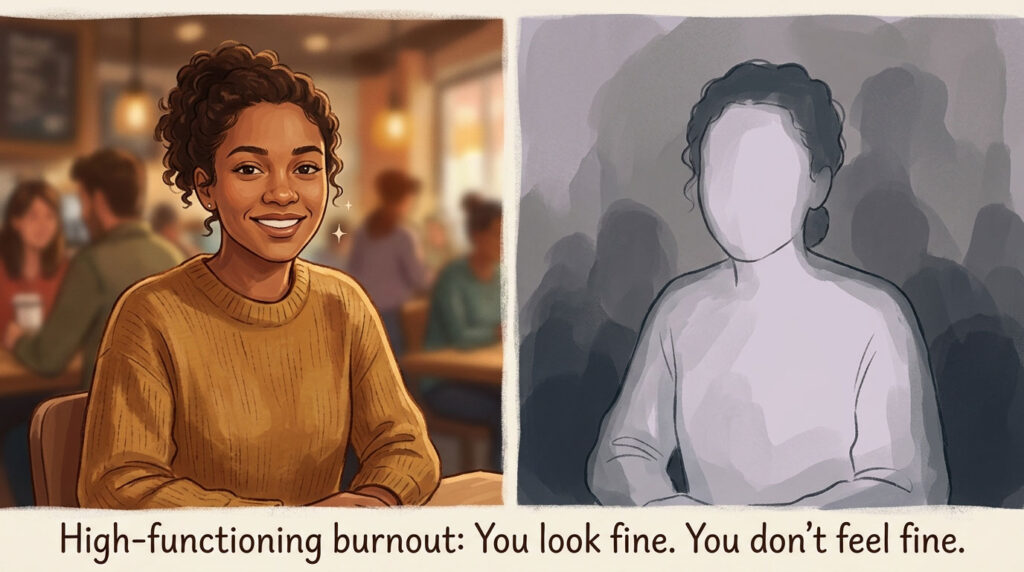
In 2025, burnout doesn’t always look like collapse. It looks like someone who shows up to every meeting, hits every deadline, and manages to smile on cue — while quietly feeling disconnected from everything they used to love. These are the people who say, “I’m fine,” and almost believe it themselves.
I had a client — let’s call her Priya — a marketing director, mother of two, and by all outward signs, absolutely thriving. She came to me because she “felt weird.” Not sad, not anxious — just flat. Like the color had been drained out of everything. That’s high-functioning burnout. And it can go undetected for years.
“I didn’t look burned out. I looked productive. That was the problem.”
If you recognize yourself in that sentence, keep reading.
Why Are So Many People Burned Out Right Now?
This is not a personal failure. Burnout has roots in the world we live in — and that world has become genuinely harder to navigate.
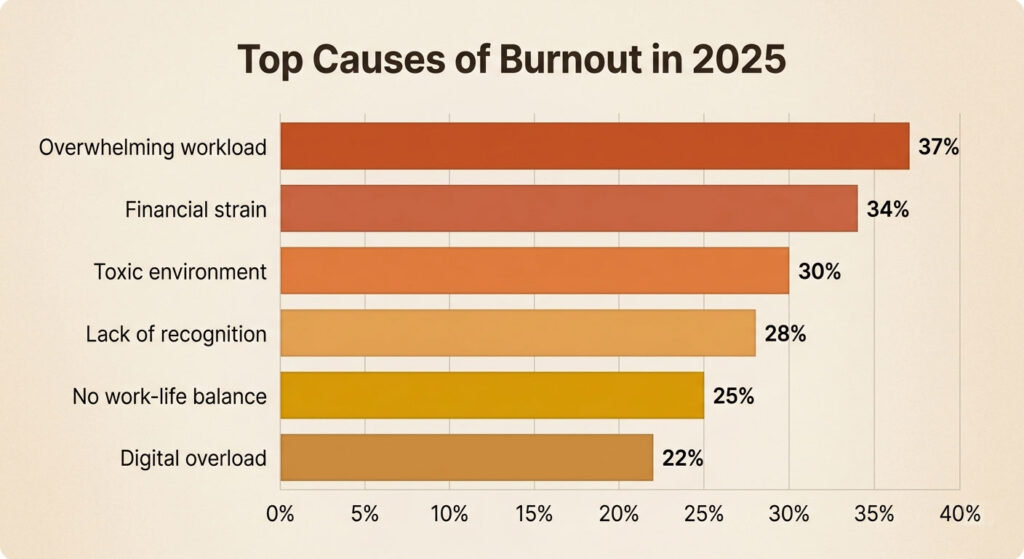
According to research compiled by Growthalista, the leading causes of burnout include overwhelming workload (37%), toxic work environments, financial strain, lack of recognition, and a total blurring of boundaries between work and personal life.
But in 2026, the picture is even more complex. Burnout isn’t just about overwork. It’s about:
The “always-on” culture. Your phone doesn’t have an off switch. Neither does your brain — not anymore. Emails at 10 PM. Slack messages on weekends. The expectation to be available, responsive, and “on” has quietly become constant. Your nervous system was never designed to live in that state.
Financial anxiety. The 2025 Aflac report found that more than 44% of employees couldn’t cover a $1,000 unexpected expense. When financial survival is a daily background stressor, it adds invisible weight to everything else you carry.
Social media pressure. You scroll through curated highlight reels of other people’s lives and quietly wonder why yours doesn’t measure up. Over time, that quiet wondering becomes chronic dissatisfaction — which feeds burnout.
The generational pressure cooker. Gen Z has now surpassed millennials as the most burned-out generation, with 74% experiencing at least moderate burnout. And research shows they’re hitting peak burnout at just 25 years old. Young people today are navigating economic instability, climate anxiety, social comparison, and identity pressure — all at once.
The gender gap in burnout. Studies consistently show that women experience burnout at higher rates than men — 59% vs. 46% — often because of the compounding weight of professional demands plus caregiving, emotional labor, and societal expectations that never fully let up.
None of this is your fault. But all of it is your reality. And understanding it is step one.
What Does Burnout Actually Feel Like? (Signs You Might Be Missing)
Here’s the tricky thing about burnout — it sneaks up on you. You don’t wake up one day completely depleted. It happens slowly, in layers, until one day you realize you can’t remember the last time you felt genuinely excited about anything.
Let’s walk through the signs — because the sooner you name it, the sooner you can address it.
Physical Signs
Your body keeps score, even when your mind tells you to push through.
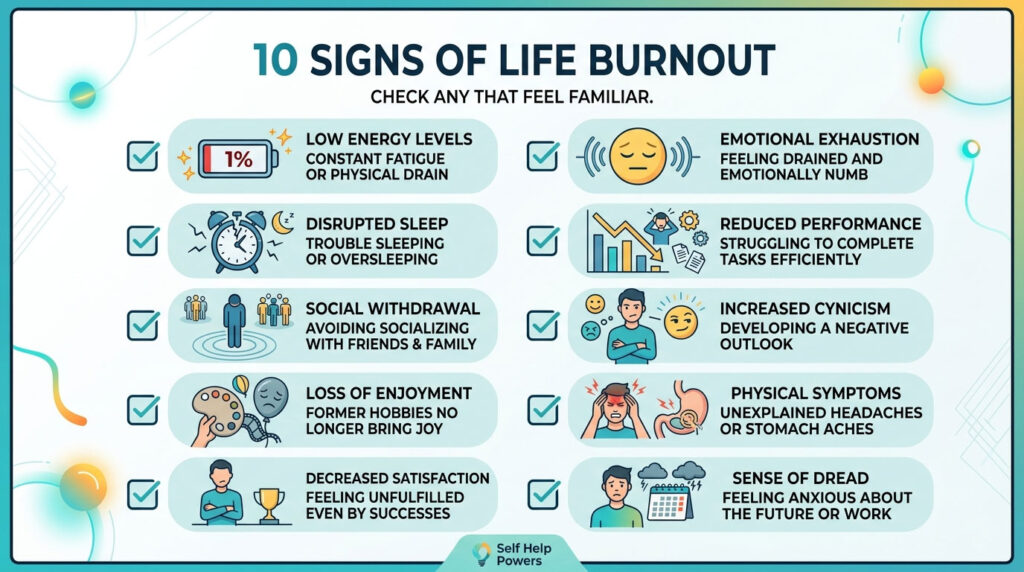
- Bone-deep fatigue that doesn’t go away no matter how much you sleep. You’re tired when you go to bed and tired when you wake up.
- Getting sick more often. Burnout weakens your immune system. Frequent colds, headaches, and stomach issues are your body’s distress signals.
- Tension headaches and body aches that seem to have no clear cause.
- Sleep disruption — either you can’t fall asleep, or you sleep too much and still feel exhausted.
As Cleveland Clinic notes, burnout often triggers physical symptoms including tension headaches, changes in eating and sleeping patterns, and a general sense of physical depletion.
Emotional Signs
- Numbness. Things that used to make you happy — a favorite song, a hug from someone you love, a sunny afternoon — feel flat.
- Cynicism and resentment. You start rolling your eyes at things that used to matter to you. Everything feels pointless.
- Irritability. Small things set you off. You snap at people you love and then feel terrible about it.
- Feeling detached from your own life — like you’re going through the motions, but not really there.
WebMD describes the second pillar of burnout as a growing cynicism — a lack of interest that can turn negative or even callous over time. That’s not who you are. That’s burnout talking.
Behavioral Signs
- Withdrawing from people you used to love spending time with.
- Procrastinating on things you normally handle easily.
- Numbing behaviors — scrolling endlessly, drinking more, eating differently, binge-watching without actually enjoying any of it.
- Fantasizing about disappearing. Not in a dangerous way — but that little daydream of just driving away and never coming back? That’s your mind screaming for relief.
Mental Health UK’s Burnout Report notes that burnout can show up as isolation, excessive reliance on alcohol or substances, and changes in eating habits — all signs that your coping mechanisms are running out.
What Are the 5 Stages of Burnout — And Which One Are You In?
Burnout doesn’t arrive fully formed. According to Premier Family Medical, it moves through predictable stages — and knowing which one you’re in helps you respond with the right level of urgency.
Stage 1 — The Honeymoon Phase
You’re energized, enthusiastic, and saying yes to everything. This is where seeds of burnout are quietly planted. Overcommitment starts here, usually disguised as passion.
Stage 2 — The Onset of Stress
The novelty wears off. You’re still functioning, but cracks are starting to show. You feel tired more often. Sleep is a bit off. Small irritations feel bigger than they should.
Stage 3 — Chronic Stress
Work and responsibilities feel like an ongoing burden. You’re regularly exhausted. Cynicism creeps in. You’re becoming less effective and starting to disengage.
Stage 4 — Full Burnout
Exhaustion is constant. Motivation has crashed. You feel hopeless about your ability to change anything. This is the stage where many people finally ask for help.
Stage 5 — Habitual Burnout
Burnout has become your baseline. It feels “normal” — but it’s not. At this point, mental health support isn’t just helpful, it’s necessary.
Most people I work with come to me somewhere between Stage 3 and Stage 4. They’ve been pushing through for so long, they forgot what “not burned out” even feels like. You can find support and tools for every stage — because no stage is too far gone to recover from.
How Long Does It Take to Recover from Burnout?
This is the question I get most often. And I always answer it honestly: it depends — but it’s always longer than you hope, and shorter than you fear.
Research suggests that mild burnout may resolve in 4 to 6 weeks with proper rest and lifestyle changes. Severe burnout, however, can take anywhere from 6 to 12 months — sometimes longer — depending on how deep it goes and what systemic changes are made.
Here’s the important part that most people miss: rest alone is not recovery.
A vacation might make you feel better for a week. But if you return to the exact same environment, the exact same habits, and the exact same boundaries (or lack of them), burnout will creep back. Often faster than before.
As explained by Chateau Health & Wellness, burnout creates real neurological and hormonal changes. It keeps your nervous system locked in a state of hyper-vigilance — where your stress response never fully turns off. That’s why you can sleep for 10 hours and still feel exhausted. Sleep helps. But healing the nervous system requires consistent, intentional lifestyle shifts over time.
True recovery means changing the conditions that caused burnout in the first place — not just taking a breather from them.
How Do You Actually Recover from Burnout? (Without Quitting Everything)
Let me be real with you: you probably can’t quit your job tomorrow. You can’t hand your kids back. You can’t make your mortgage disappear. And you don’t have to.
Real burnout recovery isn’t about blowing up your life. It’s about changing it — one intentional step at a time.
A landmark study published in the Journal of Occupational and Organizational Psychology identified six stages that people who successfully recovered from burnout moved through:
1. Admit the problem. You can’t fix what you won’t name. This step is harder than it sounds. Many of us have been told that exhaustion is just “part of adulting.” It’s not. Saying “I am burned out and I need to change something” is not weakness — it’s wisdom.
2. Create distance from your stressors. This doesn’t have to mean quitting. It could mean taking a mental health day. Setting a hard stop time for work. Saying no to one thing on your plate. Asking for help with something you’ve been white-knuckling alone. Distance, even small distance, breaks the cycle.
3. Focus on your health — starting with sleep. Research confirms that chronic sleep deprivation worsens every burnout symptom. Sleep is not a luxury right now — it’s medicine. Prioritize 7 to 9 hours. Create a “Digital Sunset” at least 90 minutes before bed: put the devices away, close the laptop all the way down, and give your brain permission to stop.
4. Question your values. Burnout often signals that you’ve been living someone else’s definition of a good life. This is the moment to ask: What actually matters to me? What have I been chasing that I don’t even want? Journaling is powerful here. You don’t need to have answers right away — just be willing to ask the questions.
5. Explore what’s possible. What would a life that felt sustainable look like? What would you do differently if you weren’t running on fumes? Let yourself dream a little — without editing yourself. At Self Help Powers, we offer courses and resources specifically designed to help you map out what a fulfilling, sustainable life can look like for you.
6. Make real, objective changes. This is where recovery becomes rebuilding. New habits. New boundaries. New conversations. Maybe new roles, relationships, or directions. Small, concrete changes stack up into a completely different life over time.
ALSO READ: Overwhelmed vs Overstimulated: What’s the Difference and Why It Matters
What Are the Best Daily Habits for Burnout Recovery?
You don’t need a dramatic overhaul. You need a few consistent anchors that remind your nervous system it’s safe to rest.
Science of People recommends these daily habits for recovery:
- Start mornings with a few minutes of slow, deep breathing — before your phone, before your to-do list.
- Take real breaks during the day. Not “scroll through Instagram” breaks. Actual breaks — walk outside, stretch, drink water without multitasking.
- Eat lunch away from your workspace, even if that just means a different room.
- Set a clear end-of-day ritual — close your laptop, change your clothes, take a short walk. Signal to your brain that work is over.
- Limit checking emails to specific times. Constant checking keeps your stress response permanently activated.
- Write down 3 small things you’re grateful for before bed. Not to toxic-positivity your way through burnout, but to gently train your attention toward what’s working.
None of these are glamorous. None of them go viral. But they work — because they address the nervous system, not just the schedule.
“I always tell my clients: start embarrassingly small. Not a morning routine — just five breaths before you check your phone. Not a wellness overhaul — just a ten-minute walk. Sustainable beats perfect every time.”

How Do You Rebuild Yourself After Burnout?
Recovery is about getting back to baseline. But rebuilding — that’s something bigger.
Rebuilding is about deciding you don’t want to go back to the exact version of life that burned you out. It’s about using this painful experience as a signal — a compass — pointing you toward a life that actually fits who you are.
This is the part I love most as a coach. Because burnout, as awful as it is, often cracks people open in the most important way. It strips away the performance and the pretending and leaves you face to face with a real question: What do I actually want my life to look like?
Here’s how to start rebuilding — not just recovering:
Reconnect with what matters to you.
As HelpGuide explains, what you do in your downtime — and how you see the world — plays just as big a role in burnout as your workload does. Rebuilding starts with getting clear on your values: what energizes you, what drains you, what you’ve been tolerating that you don’t actually want.
Write a list. What brings you joy? What makes you lose track of time in a good way? When did you last feel genuinely proud of yourself — not for what you achieved, but for who you were in a moment?
Rediscover small joys — deliberately.
Healthline recommends creating a concrete “joy list” — activities that made you feel alive before burnout dimmed the lights. Then, schedule them. Not when you “have time.” Now. Even if it’s just 20 minutes a week.
Burnout steals your ability to enjoy things spontaneously. You have to be intentional about joy until it becomes natural again.
Set new boundaries — from self-knowledge, not just exhaustion.
Most people set boundaries when they’re already at their limit. That’s reactive. Rebuilding means setting boundaries from a place of clarity about what you actually need — before you hit the wall again.
This looks like: saying no without explaining yourself. Protecting certain hours for rest. Telling the people in your life what you need, clearly and without apology.
Practice self-compassion — the real kind.
Cleveland Clinic’s psychotherapist Natacha Duke says it well: self-compassion during burnout recovery means saying — “This is a really hard time. Everybody goes through hard times. And right now, the stress in my life has exceeded my coping for too long.” Then, from that honest, gentle place, you start to problem-solve.
Not guilt. Not shame. Not “I should have seen this coming.” Compassion.
Use burnout as a turning point.
At Self Help Powers, we say this often: your lowest point doesn’t have to be the end of a story. It can be the beginning of a better one. Many of the most grounded, purposeful, genuinely happy people I’ve coached got there through — not despite — a period of total burnout. They stopped running on autopilot. They built something more intentional in its place.
That can be you.

Is It Burnout or Depression — How Do You Know?
This question matters — because the answers lead to different paths.
Here’s the simplest way to understand the difference:
| Burnout | Depression | |
| Cause | Linked to specific stressors (work, caregiving, life demands) | Affects all areas of life regardless of circumstances |
| Rest helps? | Yes — some improvement with rest and boundary changes | No — doesn’t ease with rest alone |
| Emotions | Mostly emptiness, numbness, cynicism | Pervasive sadness, hopelessness, worthlessness |
| Treatment | Lifestyle changes, boundaries, support | Therapy, sometimes medication — professional diagnosis needed |
Mental Health America is clear: burnout results from prolonged stress and is different from depression. Addressing it early can prevent long-term mental health struggles. But left untreated, burnout can develop into depression — which is exactly why catching it early matters so much.
As Legacy Community Health therapist Pilar Valenzuela Silva explains, burnout is usually tied to one area of life, while depression is more global. But both deserve attention and care — and there’s no shame in seeking it.
When should you see a professional?
- When symptoms have lasted more than a few weeks with no improvement
- When you’re having thoughts of hopelessness that don’t lift when you’re away from stressors
- When functioning in daily life — eating, sleeping, working, connecting — has become very difficult
- When you’re using substances to cope
Please don’t wait until you’re in crisis. Self Help Powers offers resources to help you understand what you’re experiencing — and to help you find the right professional support when you need it.
You Are Not Burned Out Because You Failed. You Are Burned Out Because You Cared.
You cared about your work. You cared about your family. You cared about doing things right. You kept showing up even when every signal in your body was saying slow down.
That’s not failure. That’s a heart that’s been working overtime without enough support.
But here’s what I want you to hold onto: you are not stuck here.
Burnout is not your identity. It is a season. A painful, exhausting, sometimes beautiful-in-hindsight season that is trying to tell you something important about your life.
You can recognize it. You can recover from it. And you can rebuild something — a life, a self, a rhythm — that is more yours than what you had before.
At Self Help Powers, we have articles, courses, free tools, and a community built around exactly this kind of transformation. You don’t have to figure this out alone.
Start small. Start today. Start with one honest moment of saying: “I’m burned out. And I deserve to get better.”
Because you do.
5 Frequently Asked Questions About Burnout from Life
Can you be burned out from life in general, not just work?
Absolutely. While the World Health Organization classifies burnout as an occupational phenomenon, many mental health professionals recognize life burnout as equally real. Caregiving, parenting, financial pressure, relationship strain, and identity exhaustion can all produce the same physical, emotional, and behavioral symptoms as work burnout.
What’s the fastest way to start recovering from burnout?
Admit it first — that alone shifts something. Then prioritize sleep above everything else. Set one boundary this week, no matter how small. Take one genuine break — not scrolling, but actually resting. These aren’t dramatic changes, but they signal to your nervous system that something is changing. That signal is the beginning.
How do I know if I’m burned out or just going through a rough patch?
A rough patch has an end in sight. Burnout doesn’t. If you’ve felt chronically exhausted, emotionally flat, or detached for more than a few weeks — and rest alone isn’t helping — that’s burnout. Use the 5-stage model in this post to identify where you are.
Can burnout cause physical illness?
Yes. Research links chronic burnout to a 21% increase in cardiovascular disease risk, higher stroke risk, depression, and an 84% increased risk of Type 2 diabetes. Your body and your stress response are deeply connected. Treating burnout is not just about mental health — it’s about protecting your physical health too.
How does Self Help Powers help with burnout recovery?
Self Help Powers offers a range of resources specifically designed for people at different stages of burnout and recovery — from articles and self-assessments to structured courses, curated books, and free tools. Whether you’re just beginning to recognize the signs or actively rebuilding after a crash, there’s something here to support your next step.

Author
-
 Lisa Arien is a and lead writer at Self-Help Powers, where she merges her with real-world experience to help readers achieve lasting personal growth. Known for her ability to simplify complex psychological concepts, Lisa empowers individuals to turn self-awareness into action. Her insights have been featured in , establishing her as a trusted guide in the field of self-improvement.