You’re not staying up late watching Netflix anymore. You’re staying up late doing nothing — just sitting there, too tired to sleep and too drained to do anything useful.
Monday morning arrives and your first thought isn’t about your to-do list. It’s: “How many days until Friday?”
You used to care about your work. Maybe you even loved it once. You had ideas. You had energy. You showed up ready. But lately, something has quietly shifted — and no matter how many times you tell yourself to “push through,” the tank stays empty.
Here’s what I need you to hear before we go any further:
This is not a motivation problem. This is not a discipline problem. And it is absolutely not a “you” problem.
This is burnout at work. And in 2026, it has become one of the most widespread — and most misunderstood — experiences in the modern workplace.
According to Deloitte’s workplace research, 77% of employees have experienced burnout at their current job — and more than half say it’s happened more than once. The 2025 Aflac WorkForces Report found that nearly 3 in 4 U.S. employees face moderate to very high stress at work. This is not a personal failing. This is a pattern — and it’s happening to people at every level, in every industry, all over the world.
In 12 years of life coaching, the conversation I have more than almost any other goes something like this: someone sits across from me, lists their symptoms one by one — the exhaustion, the dread, the flatness, the frustration — and then says, almost apologetically: “But I don’t know if it’s actually burnout. Maybe I’m just being dramatic.”
You’re not being dramatic. You’re being honest.
At Self Help Powers, we believe that naming what’s happening to you is the first step toward changing it. So that’s exactly what we’re going to do here — together.
By the end of this post, you’ll know the 10 specific signs that you’re past exhausted and into burnout territory. And more importantly, you’ll have a clear, step-by-step plan for what to do next.
What Does It Really Mean to Be “Past Exhausted” at Work?
Everyone has bad weeks. Everyone has stretches where work feels heavy, deadlines stack up, and Friday feels very, very far away. That’s normal. That’s stress.
Burnout is different.
The World Health Organization classifies burnout as an occupational phenomenon — a syndrome that results from chronic workplace stress that has not been successfully managed. It shows up through three specific things:
Exhaustion that rest doesn’t fix. Not just tired. Tired in your bones. Tired after a full night’s sleep. Tired on Monday morning after a restful weekend.
Cynicism and mental distance from your work. You stop caring. Things that used to matter to you — your projects, your team, your goals — start feeling hollow or pointless. You go through the motions.
A growing sense that you’re not effective. You feel like you can’t do anything right, even when your output hasn’t objectively changed. Confidence erodes. Tasks that used to be easy feel impossible.
Here’s the crucial line that separates a tough season from burnout: stress has an end in sight. Burnout doesn’t. With stress, you think, “If I just get through this project, I’ll feel better.” With burnout, you get through the project — and nothing changes.
ALSO READ: Overwhelmed vs Overstimulated: What’s the Difference and Why It Matters
What About High-Functioning Burnout?
This is the one that worries me most as a coach. Because it’s the one that goes undetected the longest.
High-functioning burnout is when you’re still showing up. You’re still hitting deadlines. You’re still smiling in meetings. But inside, you’re running on fumes — and the disconnect between how you look and how you feel is getting wider every single day.
Research from 2025 confirms that many of the most productive, most capable people in any organization are quietly living with burnout — and because they haven’t collapsed, nobody notices. Not even themselves.
You can be engaged in your work and burned out at the same time. You can love what you do and still be burning out doing it. These things are not mutually exclusive — and that’s exactly what makes work burnout so hard to catch.

What Are the Real Causes of Work Burnout in 2026?
Before we get to the signs, it helps to understand the soil burnout grows in. Because if you don’t address the root causes, you can follow every recovery tip in the world and still find yourself back in the same place six months later.
Workers today point to a predictable set of culprits: heavy workload (43%), insufficient resources (37%), micromanagement (37%), lack of recognition, and unclear expectations. But those are the surface causes. Underneath them are bigger forces at work.
The “always-on” culture. Your phone doesn’t know it’s 8 PM. Neither does your nervous system — not anymore. When the boundary between work time and personal time disappears, your stress response never fully deactivates. Over weeks and months, that constant activation erodes your capacity to cope, to think clearly, and to feel anything other than flat.
Lack of control. According to Tufts University economist Mary Davis, low-control, high-demand work settings are among the worst environments for human wellbeing. When you have no say in how, when, or where you do your work — no autonomy, no voice — stress compounds rapidly. Control is not a luxury. It’s a basic psychological need.
Financial pressure stacked on top of work pressure. The 2025 Aflac report found that more than 44% of employees couldn’t cover a $1,000 unexpected expense. When financial survival is a constant background hum, it amplifies every work stressor you already carry. The two don’t stay separate for long.
No sense of belonging. This one is underreported and deeply important. The same Aflac report found that employees who feel they belong at work report significantly lower burnout (55%) compared to those who don’t (78%). When you feel invisible, unheard, or replaceable at work, burnout takes root faster and goes deeper.
Generational pressure. Young professionals aged 18–24 are among the hardest hit, with 85% showing burnout symptoms. They’re entering the workforce carrying student debt, economic uncertainty, and digital fatigue — then being handed workloads and expectations designed for a different era.
Understanding these causes matters because burnout is not just a personal problem. It is a systemic one. And solving it requires both personal action and a clear-eyed look at the environment you’re working in.

What Are the 10 Signs You’re Past Exhausted at Work?
Not all burnout looks the same. Some people feel it as rage — short-fused, easily set off, snapping at people they love. Others feel it as numbness — a slow, quiet going-flat that creeps in without drama. Some can’t stop sleeping. Others can’t sleep at all.
But there are patterns. And the more of these you recognize, the more urgently you need to pay attention.
Sign 1: You Wake Up Tired No Matter How Much You Sleep
This is the one that confuses people most. “But I got eight hours,” they tell me. “Why do I still feel like I’ve been hit by a truck?”
Because burnout fatigue isn’t about sleep debt. It’s about your nervous system being locked in a chronic stress state — a low-level, always-on alarm that burns through your energy reserves whether you’re working or resting.
Research shows that physical exhaustion is the first symptom to manifest in 76% of burned-out workers — and critically, it includes fatigue that doesn’t improve with rest. If you’re waking up exhausted, going to bed exhausted, and feeling perpetually behind on energy you can’t seem to rebuild — that’s not tiredness. That’s burnout.
“I had a client who was sleeping nine hours a night and still needed three alarms to get up. She thought she was coming down with something. She wasn’t sick. She was burned out — and her body was trying to protect itself.”
Sign 2: Sunday Evenings Fill You With Dread
Coined by some researchers as the “Sunday Scaries,” this is more than just not wanting the weekend to end. This is a distinct, physical anxiety that arrives like clockwork on Sunday afternoon — a tightening in the chest, a mental spiral toward Monday, an inability to fully relax because your brain is already bracing for the week ahead.
This is your nervous system and your emotions communicating something important: your workplace has become a source of real, sustained threat — not just inconvenience or stress.
If Sunday evenings have stopped feeling like evenings off and started feeling like the calm before a storm — your body is trying to tell you something. Listen to it.
Sign 3: You’ve Stopped Caring About Work You Used to Love
This one hurts the most, in my experience as a coach. Because you didn’t choose to stop caring. It just… happened. Slowly, quietly, imperceptibly — until one day you looked at a project you used to pour yourself into and felt nothing.
The WHO identifies this as mental distance or cynicism — the second pillar of clinical burnout. It’s the phase where meaning drains out. Where “What’s the point?” starts replacing genuine engagement. Where eye-rolls replace enthusiasm and going through the motions replaces real investment.
This isn’t who you are. This is what prolonged, unmanaged stress does to a person. The care is still in there. It’s just buried under months — sometimes years — of depletion.
“One client of mine was a software engineer who used to spend her weekends learning new coding languages for fun. By the time she came to me, she couldn’t open her laptop without feeling a physical wave of resistance. She thought she’d lost her passion. She hadn’t — burnout had buried it.”
Sign 4: Small Tasks Feel Overwhelming
You’ve got an email to write. It’s maybe 100 words. You know exactly what to say. And yet you’ve been staring at it for 45 minutes.
Welcome to one of the quieter, stranger symptoms of burnout: cognitive overload. Research confirms that burned-out workers experience mental rigidity, lower cognitive flexibility, and impaired working memory — the exact mental tools needed for even simple tasks. Your brain isn’t lazy. It’s at maximum capacity — and the overflow means that tasks requiring almost no effort under normal conditions now take enormous willpower.
If you’re finding yourself paralyzed by a to-do list that your past self would have handled before lunch — that’s not weakness. That’s a depleted brain signaling that it needs relief, not more pressure.
Sign 5: You’re More Irritable Than Usual — Especially at Work
Short fuse. Low patience. A colleague says something mildly frustrating and you feel a disproportionate flash of anger. You snap at someone in a meeting and immediately feel terrible. You come home from work and take it out on the people who had nothing to do with it.
According to Cleveland Clinic, mood changes are a hallmark burnout symptom — you become more irritable, more on edge, and small stressors trigger frustration that feels outsized. This happens because chronic stress depletes the brain’s ability to regulate emotion. You’re not becoming a worse person. You’re running on an emotional reserve that’s nearly empty.
The guilt that comes with snapping at people you love often makes burnout worse — adding shame on top of exhaustion is a brutal combination. Be gentler with yourself here. Recognizing the irritability as a symptom, not a character flaw, is the first step to addressing it.
Sign 6: You’re Getting Sick More Often
Colds that won’t quit. Headaches that appear out of nowhere and stay for days. Stomach issues you can’t explain. A general sense of physical fragility that didn’t used to be there.
The connection between burnout and physical health is not subtle. Chronic stress suppresses the immune system, raises cortisol levels, increases inflammation, and has been linked to a 21% increased risk of cardiovascular disease and an 84% increased risk of Type 2 diabetes. Your body is not separate from your stress — it is where your stress lives.
If you’ve noticed you’re getting knocked down by every bug that comes through the office, or that small physical complaints are stacking up — pay attention. Your body is not being dramatic. It’s keeping score.
Sign 7: You’re Numbing Out After Work
You come home, sit on the couch, open your phone, and three hours disappear. Not because you enjoyed anything you watched or scrolled through — but because you needed to exist in a state that required nothing of you.
This is numbing. And it’s one of the most common — and least talked about — behavioral signs of work burnout.
Mental Health UK’s Burnout Report identifies behavioral changes like increased alcohol use, altered eating habits, and social withdrawal as key indicators that someone has moved from stress into burnout territory. When your coping mechanisms start doing the work that rest and joy used to do — that’s a signal worth taking seriously.
Numbing isn’t weakness. It’s your mind’s attempt to give you a break from a pressure it can’t otherwise escape. But it doesn’t actually restore anything. And over time, it deepens the depletion.
“A client once described his evenings as ‘sitting in the dark with my phone, not really watching anything, just waiting for it to be an acceptable time to go to sleep.’ That’s not unwinding. That’s shutdown mode.”
Sign 8: Your Performance Is Slipping — and You Can’t Pull It Together
You used to deliver. You were known for it. Now you’re missing small details, forgetting things, producing work that feels below your own standard — and the harder you try to fix it, the worse you feel.
According to data from Apollo Technical, behavioral changes in burnout include decreased performance, missed deadlines, withdrawal from team interactions, and difficulty concentrating. Critically, these changes intensify gradually — they don’t arrive all at once. That gradual slide makes them easy to explain away until they’re impossible to ignore.
The shame spiral that comes with this is real and brutal: you’re exhausted, which hurts your performance, which makes you feel like a failure, which adds emotional weight to the exhaustion, which makes performance worse. Breaking that cycle requires self-compassion before strategy — something we’ll get to in the action plan below.
Sign 9: You’ve Started Fantasizing About Quitting — Or Disappearing
Not necessarily in a dark way. More like: What if I just… didn’t go in tomorrow? What if I got in the car and drove somewhere? What if I quit everything and started over somewhere no one knows me?
These aren’t idle daydreams. They’re your mind’s way of generating an escape from an environment that feels inescapable. Research from Apollo Technical found that 64% of employees have thought about quitting because of burnout. And the APA reports that 3 in 5 employees experience negative impacts from work-related stress significant enough to affect their daily functioning.
The fantasy of escape is not a plan — and acting on it impulsively rarely solves the underlying problem. But it is a very loud signal that something needs to change. At Self Help Powers, we help people turn that vague fantasy into a real, thoughtful plan — because sometimes staying and healing is the answer, and sometimes leaving really is.
Sign 10: You Feel Trapped, But Too Drained to Change Anything
This is the most insidious sign of all. Because it closes the loop. You’re exhausted enough that change feels impossible. But nothing will change unless you do something different. And doing something different requires energy you don’t have.
This is the burnout paradox. And it keeps millions of people stuck in situations that are slowly hollowing them out — not because they don’t want change, but because burnout has sapped the very capacity needed to create it.
If this is where you are right now — if you feel both desperate for change and completely unable to move toward it — this is not permanent. It feels permanent. But it isn’t. The action plan in the next section is specifically designed to break this loop with the smallest possible steps.
ALSO READ: Burnout from Life: How to Recognize It, Recover from It, and Rebuild Yourself
Is Work Burnout the Same for Everyone — Or Does It Show Up Differently Depending on Your Role?
One thing I want to be clear about: burnout does not have one face.
If you’re an employee, burnout often shows up as the slow erosion of motivation — the feeling of being a cog in a machine that doesn’t notice or care if you’re struggling.
If you’re a manager, the picture is uniquely painful. Cariloop’s 2025 research found that managers are expected to spot burnout in their teams, model healthy boundaries, and support others’ mental health — often without any training, tools, or support for their own. When managers burn out, the damage ripples outward: their teams disengage, turnover climbs, and morale drops. You can’t pour from an empty cup — and yet managers are asked to do exactly that, every single day.
If you’re freelance or self-employed, burnout carries its own brand of cruelty. The freedom that drew you to independent work becomes a liability when there is no off switch, no HR department, no paid leave, and no clear boundary between “at work” and “at home.” The pressure to always be available — to clients, to opportunities, to income — is relentless. And because there’s no boss to blame, self-employed people often turn the blame inward.
The gender dimension is also real and documented. Research consistently shows that women experience burnout at higher rates than men — 59% vs. 46% — driven in part by the compounding weight of professional responsibilities layered on top of caregiving, emotional labor, and societal expectations that don’t ease up when the workday ends. Women leaders, in particular, often carry the emotional wellbeing of their entire teams while managing their own depletion in silence.
Wherever you sit in this picture — knowing your specific version of burnout helps you address the specific causes. One-size-fits-all advice rarely works. What works is honest, specific, personal action.
What Should You Do Next If You Recognize These Signs?
Here is what I know from years of coaching people through burnout: most people know they’re burned out long before they do anything about it. The gap between knowing and acting is where burnout deepens.
So let’s close that gap. Right now. With a clear sequence — not a list of vague suggestions, but an actual order of operations for what to do next.
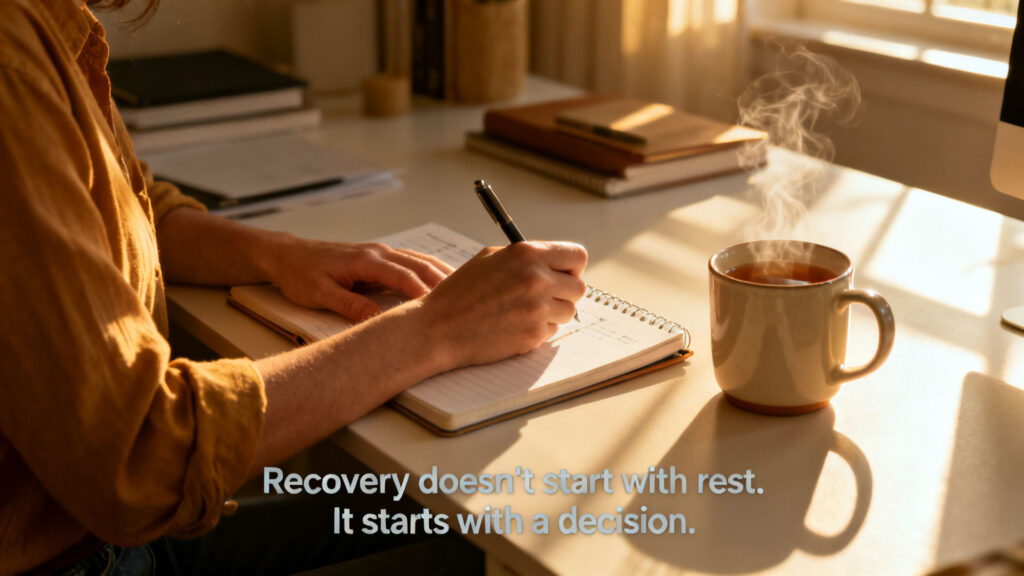
Step 1: Name It Out Loud
Not in your head. Out loud — to yourself, to someone you trust, or in writing.
There is real psychological power in saying: “I am burned out. This is burnout. And I need to take it seriously.” Most people skip this step because naming it feels like admitting failure. It’s not. It’s the opposite — it’s taking your own experience seriously enough to address it honestly.
Say it. Write it. Tell one person. Let it become real.
Step 2: Do a Ruthless Workload Audit
Take a piece of paper and make three columns: Must Do (only me), Can Delegate, Can Drop.
Most people’s workloads have more in the second and third columns than they realize. We hold onto tasks out of habit, guilt, or the belief that doing it ourselves is easier than asking. In burnout, that belief is costing you more than you know.
Research from Maricopa Corporate highlights that ruthless task prioritization — deciding what can wait, what can go, and what can be redistributed — is one of the highest-leverage moves a burned-out person can make. Drop one thing this week. Just one. See how it feels.
Step 3: Set One Non-Negotiable Boundary This Week
Not five new boundaries. Not a complete overhaul. One.
Maybe it’s: “My laptop closes at 7 PM and doesn’t reopen.” Maybe it’s: “I am not checking Slack on weekends.” Maybe it’s: “I am taking a real lunch break — away from my desk — every day this week.”
One boundary. Non-negotiable. Protected like a meeting you cannot cancel. This is how boundaries become real — not through grand declarations, but through consistent, repeated practice.
“People ask me: ‘What if my boss doesn’t respect my boundaries?’ My answer: What’s happening now, with no boundaries? Is that working? Start somewhere. You can negotiate the details as you go.”
Step 4: Talk to Someone — At Work or Outside It
Studies confirm that employees who engage in structured mental health support recover from burnout 40% faster than those who try to manage it alone. Burnout is not a solo project. It doesn’t respond well to isolation and willpower.
This might mean talking to your manager — a conversation we’ll address in a moment. It might mean confiding in a trusted colleague. It might mean starting therapy or working with a coach. It might mean joining a community of people navigating the same thing.
At Self Help Powers, we offer courses, resources, and community built specifically for people at this stage — because knowing you’re not alone changes something real in how recoverable burnout feels.
Step 5: Protect Your Recovery Time Like It’s a Meeting
Here’s a truth that took me years to fully believe: rest is not the absence of work. Rest is work — specifically, it’s the work of recovery.
The American Psychiatric Association recommends even a 20-minute walk to reduce stress hormones and regulate mood. Research shows that employees who take regular vacations are significantly less likely to experience burnout. Block recovery time in your calendar. Name it. Show up to it. Protect it from other obligations the way you’d protect your most important client meeting.
Step 6: Reconnect With What Made Work Meaningful
Somewhere under the burnout, the thing that brought you to this work still exists. Maybe it’s been buried so long you’ve forgotten it was ever there. But it is.
Ask yourself — without editing, without cynicism — what did you originally care about in this work? What did it feel like when it was good? Even one small, honest answer to that question can become a thread to follow back toward meaning.
As BSW Health psychologist Dr. Kenleigh McMinn notes, burnout is often described as an erosion of the soul — meaning recovery requires finding a new sense of enthusiasm, not just managing the symptoms. Reconnecting with purpose is not soft advice. It is the core of sustainable recovery.
Step 7: Know When to Have the Bigger Conversation
Some burnout is situational — tied to a specific project, a bad season, a temporary set of pressures that can be addressed and relieved. Some burnout is systemic — rooted in the culture, the leadership, or the fundamental structure of a role or organization that is not going to change.
Knowing the difference matters.
If your burnout is situational, a conversation with your manager — done with clarity and without shame — can open real options: redistributed responsibilities, adjusted timelines, different support structures. Mayo Clinic recommends being direct about your needs while remaining open to what’s possible within your current role.
If your burnout is systemic — if the environment itself is the problem and no conversation is going to change that — the bigger conversation may be with yourself. About what you actually need. About whether this role, this organization, or even this industry is sustainable for you long-term. That’s a harder conversation. But it’s also one of the most important you’ll ever have.
Self Help Powers has resources specifically for this crossroads — for people who are trying to figure out whether to stay, adapt, or move on with intention rather than desperation.
When Is Work Burnout a Sign That You Need to Leave — Not Just Recover?
This is the question most burnout articles won’t answer directly. But I will.
Not every burnout situation is fixable from the inside. There are workplaces where the conditions that cause burnout are not going to change. There are managers who will not support you. There are cultures where your wellbeing is not a consideration. And staying in those environments while trying to “recover” is like trying to heal a wound while it’s still being reopened every day.
Ask yourself these three questions honestly:
Is the burnout tied to specific, changeable conditions — or to the fundamental nature of this workplace? Specific conditions can often be negotiated or adjusted. Fundamental culture cannot be wished away.
Have you asked for what you need — clearly, directly — and been met with dismissal? If you’ve named the problem and been told it’s your problem to manage, that’s important data.
Does imagining staying here for another two years make you feel anything other than dread? Your gut knows things your logic hasn’t caught up to yet.
Leaving is not failure. Leaving a situation that is actively harming you is an act of self-preservation — and sometimes, it’s the most powerful step in a burnout recovery plan. The Society for Human Resource Management found that 34% of workers have accepted lower-paying jobs to protect their mental health — and for many of them, it was the right call.
At Self Help Powers, we help people make this decision with clarity and intention — not from panic, not from desperation, but from a clear understanding of what they need and deserve.
You Are Not Past the Point of Recovery. You Are Just Past the Point of Ignoring It.
Let’s be honest about where you might be right now.
Maybe you recognized yourself in three of those ten signs. Maybe you recognized yourself in all ten. Maybe you’ve been reading this and quietly thinking, “This is me. This has been me for a while.”
If so — good. Not good that you’re burned out. Good that you’re seeing it clearly, possibly for the first time.
Because here’s what I know from years of working with people who thought they were too far gone to come back: they weren’t. Not one of them. The people who felt the most trapped, the most depleted, the most hopeless about change — they recovered. They rebuilt. And most of them, looking back, said that burnout — painful and costly as it was — cracked open something important. It forced a reckoning with what they actually needed, what they actually wanted, and who they actually were outside of their productivity.
That reckoning can be yours too.
But it starts with one honest decision: to stop pushing through and start paying attention.
At Self Help Powers, we have everything you need for that next step — articles, courses, free tools, and a community of people navigating exactly what you’re navigating. You don’t have to figure this out alone. You were never supposed to.
Start here. Start now. Start with one small, honest step.
Because you deserve a work life — and a life — that doesn’t cost you everything to show up for.
Frequently Asked Questions About Work Burnout
What are the first signs of burnout at work?
The earliest signs are often subtle: persistent fatigue that sleep doesn’t fix, a growing dread of going to work, and a creeping sense of cynicism toward tasks or people you used to engage with enthusiastically. Many people also notice increased irritability and difficulty concentrating before they recognize the bigger picture. The earlier you catch it, the easier it is to address.
Can you be burned out but still like your job?
Yes — and this is one of the most important things to understand about burnout. You can genuinely love what you do and still be burning out while doing it. Passion does not protect you from unsustainable conditions. In fact, people who care deeply about their work are sometimes more vulnerable to burnout, because they push harder and longer before they allow themselves to acknowledge the cost.
Should I tell my boss I’m burned out?
It depends on your relationship with your manager and your workplace culture. If your manager is supportive and your workplace values wellbeing, a clear, direct conversation can open up real options — adjusted workloads, additional support, or flexible arrangements. If your workplace culture dismisses or penalizes people for being honest about their mental health, consider speaking with HR, an employee assistance program, or a trusted mentor instead before going to your direct manager.
How do I recover from burnout without taking time off?
Recovery without time off is possible — but it requires being very intentional about the time you already have. Set one firm work boundary. Protect evenings and weekends from work intrusion. Build small recovery rituals into your existing routine: real lunch breaks, brief outdoor walks, a strict end-of-day cutoff. Simultaneously, start reducing your workload through delegation and deprioritization. Time off helps — but systemic change matters more. Without changing the conditions, even a two-week vacation only delays the return of burnout.
How is burnout at work different from regular work stress?
Stress involves too much — too many demands, too little time. It’s overwhelming, but it usually has a resolution in sight. Burnout is the opposite: it’s about too little — too little motivation, emotion, energy, or capacity to care. The clearest distinction is this: stress eases when the pressure does. Burnout doesn’t. If a weekend or a vacation leaves you feeling just as empty as before, that’s the line between stress and burnout — and it’s worth paying attention to.

Author
-
 Lisa Arien is a and lead writer at Self-Help Powers, where she merges her with real-world experience to help readers achieve lasting personal growth. Known for her ability to simplify complex psychological concepts, Lisa empowers individuals to turn self-awareness into action. Her insights have been featured in , establishing her as a trusted guide in the field of self-improvement.