Key Takeaways
- Your brain is wired for negativity, and that’s not your fault. It’s biology.
- The Reticular Activating System (RAS) is the brain’s “search engine.” What you focus on, it finds more of.
- Neuroplasticity means you can literally rewire your brain toward positivity with consistent daily habits.
- Positivity alone isn’t enough, it’s the fuel. Action is the vehicle.
- A 10-minute daily practice can shift your mindset faster than you think.
- Learn the most effective ways on how to manifest positivity
I want to tell you about a client I’ll call Emma.
Emma had been doing “all the right things” for two years. She had affirmations on her mirror. She had a vision board. She journaled every morning and tried her best to “stay positive.”
But she still felt like she was pushing a boulder uphill every single day.
“Lisa,” she told me during one of our coaching sessions, “I feel like positivity is this thing that everyone else just has. Like they were born with it. And no matter how hard I try, it slips right through my fingers.”
Does that sound familiar?
Here’s what I told Emma, and what I want to tell you right now:
You are not broken. You are not failing. And you were not born without the ability to be positive.
Your brain is simply doing exactly what it was designed to do. And once you understand how it works, you can change it.
That’s what manifesting positivity really is. Not a magic trick. Not toxic optimism. Not pretending bad things don’t happen. It’s a trainable, science-backed skill, and at Self Help Powers, we believe it’s one of the most life-changing things you can learn.
By the end of this post, you’ll know exactly why your brain fights positivity, what’s actually happening in your brain when you manifest, and a simple 10-minute daily practice that works, even on hard days.
📘 Ready to go deeper? Download the free Self Help Powers Manifestation Workbook and get 30 done-for-you journaling templates to start your practice today.
What Does It Really Mean to Manifest Positivity?
Let’s clear something up right away, because there’s a lot of confusion about this topic.
Manifesting positivity is not about forcing yourself to smile when you’re struggling. It’s not about pretending everything is fine. And it’s definitely not about chanting affirmations and waiting for the universe to do all the work.
The law of attraction, the idea that what you focus on, you attract more of, sounds simple. But the real mechanism behind it is far more fascinating than most people realize.
Manifesting positivity means consciously training your attention toward what you want to experience more of. It means using your mind as a tool, not a weapon against yourself.
Think of it this way. Your brain works like a search engine. If you keep typing in “nothing ever goes right for me,” that’s all it returns. But the moment you change the search query, even a little, the results start to shift.
That shift is what manifestation really is.
Is manifesting positivity the same as “positive thinking”?
Sort of, but with one big difference.
“Positive thinking” often gets dismissed because it feels passive. Think happy thoughts, and good things will happen. But that’s not quite it.
Manifesting positivity is about aligning your emotional state, your intentions, and your actions toward what you want to create. It’s an active practice, not a wishful mindset. The thoughts come first. But the actions always follow.
What’s the difference between toxic positivity and true manifestation?
Toxic positivity says: “Just be happy. Don’t feel bad.”
True manifestation says: “Feel what you feel, and then consciously choose where to direct your energy.”
One of those suppresses your emotions. The other uses them as fuel. That’s a world of difference. And it’s a distinction I’ve seen transform people’s lives in my coaching work at Self Help Powers.
Why Does Your Brain Naturally Fight Positivity?
Here’s the truth that most “manifest positivity” articles skip completely, and it’s the key that unlocks everything.
Your brain is not neutral. It is deeply, biologically, structurally biased toward the negative.
And this isn’t a character flaw. It’s a 200,000-year-old survival feature.
Research on negativity bias shows that our ancestors who paid more attention to threats, the rustle in the bushes, the stranger approaching, survived longer than those who didn’t. The ones who stayed relaxed and positive? Sometimes they got eaten.
So the brain evolved a simple rule: bad news first. Always.
Neuropsychologist Rick Hanson describes it beautifully: your brain is like Velcro for negative experiences and Teflon for positive ones. Bad things stick. Good things slide right off.
In fact, research suggests that 70 to 80 percent of our daily thoughts lean negative, not because life is bad, but because the brain is constantly scanning for threat. And a 2020 study found we have more than 6,000 thoughts per day. That’s a lot of negativity running on autopilot.
No wonder positivity feels like work.
One of my coaching clients described it perfectly. “It’s like I have a smoke alarm that goes off for everything, not just actual fires. Someone doesn’t reply to my text for two hours and my brain is already writing the disaster story.”
Sound familiar? That’s your negativity bias doing its job. The problem is, in modern life, it’s dramatically overqualified.
What is the negativity bias and how does it block manifestation?
The negativity bias doesn’t just make you feel bad. It actively filters what you see.
When you’re locked in a negative mindset, your brain literally begins to screen out evidence that contradicts it. You stop noticing the opportunities, the kindnesses, the small wins. Not because they aren’t there, but because your brain has decided they’re not important enough to process.
This is exactly why people who’ve decided “nothing ever works out for me” keep finding evidence that confirms it. The brain finds what it’s looking for.
The good news? You can reprogram the search terms.
What is the Reticular Activating System, and why does it matter for manifesting positivity?
This is where it gets genuinely exciting.
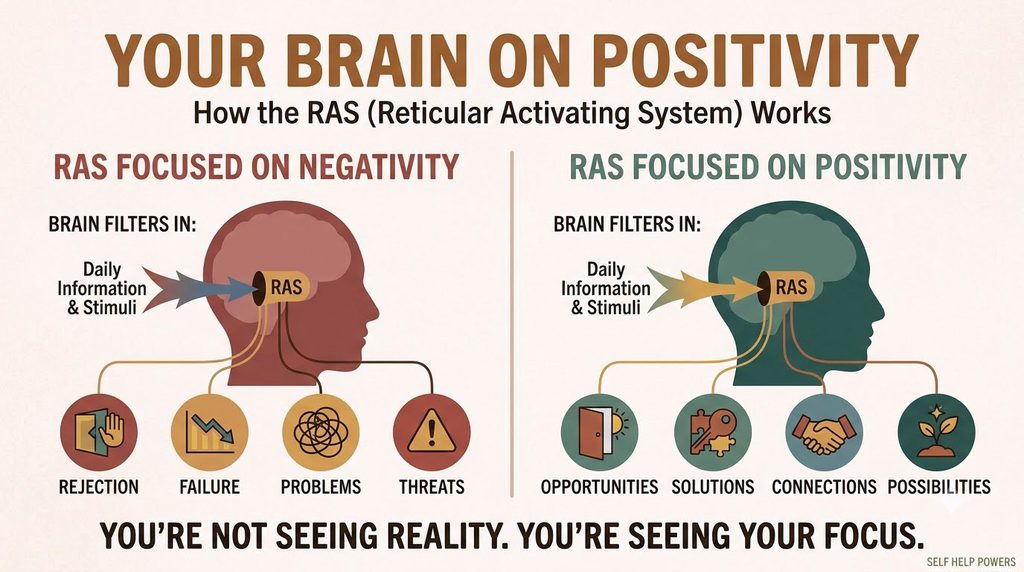
Deep in your brainstem sits a bundle of neurons called the Reticular Activating System, or RAS. It acts as the brain’s gatekeeper. According to neuroscience research, your brain processes up to 11 million bits of information every second. But your conscious mind can only handle around 40 to 50 bits.
The RAS decides what makes it through. Everything else gets filtered out.
Here’s a classic example you’ve probably experienced yourself. You decide you want a new car, let’s say a silver Honda. Suddenly, you see silver Hondas everywhere. They didn’t multiply overnight. Your RAS simply told your brain: this is relevant. Pay attention to it.
This is the real science behind the law of attraction. Focus on positivity, and your RAS starts filtering your reality to find more of it. Focus on problems, and it finds problems. The universe isn’t rearranging itself, your perception is shifting.
“I used to wonder why some of my clients seemed to magnetically attract good news,” I told Emma. “Now I know. Their RAS was tuned to a different frequency. And yours can be too.”
How Does Manifesting Positivity Actually Work in the Brain?
Now that you understand why positivity is hard, let’s talk about what actually happens when you start practicing it.
The brain has a remarkable ability called neuroplasticity, its ability to physically change and form new neural pathways in response to what you repeatedly think, feel, and do.
Every time you practice gratitude, every time you reframe a negative thought, every time you write down a positive intention, you are literally rewiring your brain. You are strengthening the neural pathways that make positive thinking easier, more automatic, and more natural over time.
Gratitude activates the brain’s reward system, releasing dopamine and serotonin, the same chemicals associated with pleasure and well-being. These aren’t just “feel good” moments. Each release is also a signal to the brain: do this again.
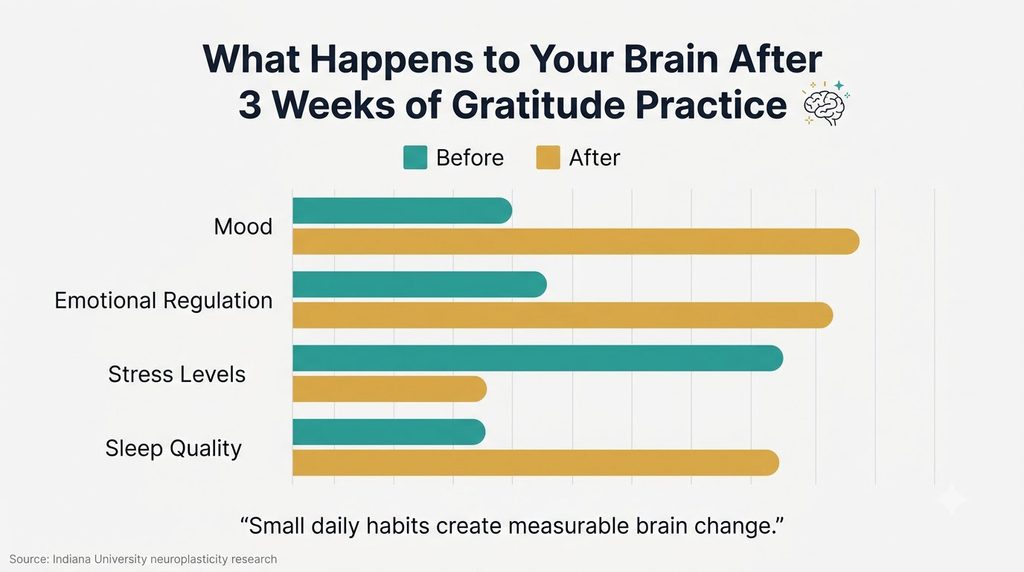
One of the most powerful studies on this topic comes from Indiana University. Researchers had participants write gratitude letters over three weeks and then used functional MRI scans to measure brain activity. They found sustained activation in the prefrontal cortex, the region responsible for decision-making, emotional regulation, and empathy, even months after the study concluded.
That’s not a mood boost. That’s actual structural brain change.
And research from Stanford neurosurgeon Dr. James Doty confirms that belief and visualization activate the brain regions linked to achieving goals. Manifestation isn’t magic. It’s your brain performing its natural, measurable functions, just with intention.
Now here’s the honest part that most articles leave out.
A 2023 study by Dixon and colleagues found something important: people who practiced manifestation without taking action didn’t show higher levels of wealth, success, or well-being than non-manifesting peers. Positive thinking alone doesn’t move the needle.
Manifesting positivity is like charging a battery. But a charged battery sitting in a drawer doesn’t power anything.
Positivity is the fuel. Action is the vehicle.
When Emma finally understood this, everything clicked. She stopped waiting for the universe to deliver her a better life. She started using her daily gratitude practice to wire her brain toward solutions, and then she moved toward them.
Within six weeks, she’d applied for a new job she would have previously talked herself out of. She’d reconnected with a friendship she’d let decay. And she told me she felt more genuinely positive than she had in years.
Not because she forced it. But because she’d trained her brain to look for it.
Want to write your first manifestation script in under 30 seconds? Try the free Self Help Powers Manifest Generator, just type in what you want to create, and it’ll generate a personalized script for you.
What Are the Most Effective Ways to Manifest Positivity Every Day?
Here’s the part I love most. Because this doesn’t require an hour of your morning or a perfectly curated routine.
The clients who transformed fastest in my coaching practice weren’t the ones with the most elaborate practices. They were the ones who were consistent with three small, intentional habits. That’s it.
Here’s the exact 10-minute daily framework I teach at Self Help Powers. It’s built around the neuroscience we’ve covered, and it works.
🌅 Morning (5 minutes): Set Your RAS
Step 1, Gratitude journaling (3 minutes)
Before you check your phone, write three things you’re grateful for. Not generic ones. Specific ones.
Not: “I’m grateful for my family.” Instead: “I’m grateful for the way my sister texted me out of nowhere yesterday just to say she was thinking of me.”
The specificity matters. Gratitude activates the prefrontal cortex, and the more vividly you feel it, the stronger the neural response. You’re telling your RAS: this is the frequency I want to tune into today.
Step 2, One spoken affirmation (2 minutes)
Stand in front of a mirror. Look yourself in the eye. Say one affirmation aloud, not as a wish, but as a present-tense truth you’re stepping into.
Not: “I hope I feel positive today.” Instead: “I am someone who notices what’s going right.”
Morning affirmations spoken aloud set a positive tone that influences the rest of your day. The mirror element is intentional, it builds self-connection and makes the words land deeper.
☀️ Midday (2 minutes): Reset and Reframe
Somewhere in the middle of your day, during lunch, a coffee break, or a walk, pause for two minutes.
Ask yourself one question: “What went right this morning?”
This is an RAS reset. You’re actively redirecting your brain’s attention filter away from everything that went wrong and toward evidence of what went well. Even if it’s small. Especially if it’s small.
Then take any one negative thought you’ve been carrying and flip it. Not into a lie, into a possibility.
Not: “This project is going badly.” Reframe: “This project is teaching me what I need to change.”
That single cognitive shift creates a different emotional experience, which creates different decisions, which creates different outcomes.
🌙 Evening (3 minutes): Script and Release
Step 1, Scripting (2 minutes)
Write one or two sentences about something you want to manifest, as if it has already happened. In the present tense. With emotion.
“I feel so calm and confident in my new home. I love how the light comes through the windows in the morning.”
Writing down goals makes you 42 percent more likely to achieve them, according to research by psychologist Dr. Gail Matthews at Dominican University. When you write your future as if it’s real, you’re giving your RAS a clear target to aim at.
Step 2, Release (1 minute)
Close the journal. Take a breath. Let it go.
This step is more important than it sounds. Obsessing over what you want to manifest creates resistance. It sends the signal: I don’t have this yet. I’m afraid I won’t get it. That fear frequency is what you’re trying to shift away from.
Write it, feel it, then trust it. Let your RAS work on the problem while you sleep.
Does writing down what you want to manifest actually help?
Yes, and the science is clear on this. Dr. Gail Matthews’ research at Dominican University found that more than 70 percent of participants who wrote down their goals and sent weekly updates to a friend reported successful achievement, compared to just 35 percent who kept their goals to themselves without writing them down.
Writing externalizes your intention. It makes vague hopes concrete. And it gives your brain something specific to organize around.
How do affirmations help you manifest more positivity?
Affirmations work through repetition-driven neuroplasticity. Each time you repeat a positive statement with genuine emotion, you strengthen the neural pathways associated with that belief. Studies using fMRI scans show that consistent positive practices activate the prefrontal cortex, improving decision-making, emotional regulation, and the ability to sustain focus on what you want.
But there’s a key rule: affirmations have to feel reachable, not delusional. “I am a billionaire” when you have $47 in your account will trigger cognitive dissonance and shut the process down. “I am someone who makes smart financial decisions every day”, that the brain can work with.
Can you manifest positivity even when you’re going through something hard?
This is the question I get asked most often. And the answer is yes, in fact, that’s when it matters most.
Manifesting positivity during hard times isn’t about pretending things are fine. It’s about deliberately choosing where to direct your available attention. Even five minutes of intentional gratitude in the middle of grief, stress, or fear creates a measurable shift in brain chemistry.
You don’t need to feel positive to start the practice. You start the practice to create the feeling.
What Habits Are Silently Blocking Your Positive Manifestations?
Here’s the section most blogs skip. And honestly, it might be the most important part.
I’ve watched brilliant, beautiful, determined people stay stuck for years, not because they weren’t trying hard enough, but because they were unknowingly fueling the exact energy they wanted to escape.
These are the five biggest blockers I see in my coaching practice at Self Help Powers. Check yourself honestly against each one.
1. Doom-Scrolling and Negative Media Consumption
Your RAS doesn’t know the difference between your real life and the news feed. Every threat-signal your brain absorbs, every disaster story, every conflict, every fear-based headline, reinforces the negativity bias. Research confirms that negativity bias is hardwired but not fixed. What you feed it becomes your default filter.
Set a media boundary. Not zero news, but intentional, limited exposure. Especially first thing in the morning before your RAS is set.
2. Negative Self-Talk You’ve Normalized
“I’m such an idiot.” “Of course this happened to me.” “I always mess things up.”
These feel like throwaway comments. They’re not. Your subconscious mind cannot tell the difference between a joke and a belief. Every time you speak negatively about yourself, you’re scripting your own limitations directly into your RAS.
Start noticing when you do it. You don’t have to be perfect, just catch it, and redirect.
3. Comparison Spiraling
Comparison is one of the fastest ways to flood your nervous system with scarcity energy. When you’re focused on what someone else has that you don’t, your brain is reinforcing a lack narrative, and your RAS starts filtering your reality through that lens.
Use social media with intention. Curate your feed toward accounts that inspire you, not destabilize you.
4. Expecting Instant Results
Neuroplasticity is real, but it takes time. The Indiana University gratitude study showed brain changes after three weeks of consistent practice. Not three days.
Most people quit their positivity practice right before the shift happens. They try journaling for four days, feel nothing dramatic, and decide it doesn’t work. Don’t be that person.
Some people notice a shift in a few days. For deeper rewiring, a few weeks of consistency is what creates lasting change. Trust the process long enough to actually see it work.
5. Suppressing Emotions Instead of Processing Them
This is the sneaky one. A lot of people confuse manifesting positivity with avoiding negative emotions entirely. They feel sad or angry and immediately try to “think positive.” That’s emotional suppression, and it actually increases stress hormones and blocks the authentic positive states you’re trying to create.
You need to give yourself space to feel difficult emotions so you can move through them. Acknowledge the feeling. Name it. Then redirect your attention. That’s the healthy sequence.
💎 30-DAY SYSTEM: If you want a structured path that tackles all five of these blockers, one step at a time, in the right sequence, the Self Help Powers 30-Day Positivity & Manifestation System was built exactly for this. It gives you a daily action, a daily mindset shift, and a daily check-in so nothing slips through the cracks. [Start your 30-day journey here →]
Are You Ready to Start Manifesting Positivity Today?
Let’s bring it all together.
Your brain naturally leans negative, not because you’re broken, but because you’re human. The negativity bias kept your ancestors alive. But in today’s world, it’s working against you.
The Reticular Activating System is your brain’s search engine. What you focus on consistently, it filters in, opportunities, connections, solutions, and possibilities. What you ignore, it filters out.
Neuroplasticity means that with consistent, intentional practice, you can physically rewire your brain toward positivity. Gratitude, affirmations, scripting, and reframing aren’t just “feel good” exercises. They are tools that change your brain chemistry, releasing dopamine and serotonin, strengthening neural pathways, and recalibrating your RAS toward what you want to create.
But here’s the non-negotiable truth: positivity is the fuel. Action is the vehicle. Manifesting positivity means training your mind and moving your feet.
Start with 10 minutes a day. Three things you’re grateful for. One affirmation spoken aloud. One reframe at midday. One evening scripting sentence. That’s it.
I’ve watched this simple practice change people’s lives, and I’ve lived it myself. The shift doesn’t feel dramatic at first. It feels quiet. And then one day you realize you’re noticing more of what’s going right. You’re taking more chances. You’re attracting better conversations, better opportunities, better days.
That’s manifesting positivity. And it starts today.
At Self Help Powers, we believe that every person has the power to create a more positive, intentional life, and we’re here to help you do it.
Take the next step with the Self Help Powers 30-Day Manifestation System, a structured, day-by-day guide that takes you from where you are to where you want to be. Real habits. Real science. Real results. [Join thousands of people already on this journey →]
Frequently Asked Questions
How long does it take to manifest positivity?
It depends on how consistent you are. Research shows some people notice a shift in days, while deeper rewiring of neural pathways takes three to four weeks of daily practice. The key is consistency, not intensity. Ten minutes every day beats one hour on the weekend.
Can negative thoughts ruin my manifestation?
No, and this is important. Having negative thoughts does not cancel your manifestation. As neuroscience explains, the brain will always produce negative thoughts because of the negativity bias. What matters is not eliminating them but not dwelling in them. Notice the thought, name it, and redirect without judgment.
What’s the best morning routine for manifesting positivity?
Keep it simple and do it before you check your phone. Write three specific things you’re grateful for, then say one present-tense affirmation aloud in the mirror. That’s five minutes and it sets your RAS for the entire day. Complexity is the enemy of consistency.
Is manifesting positivity the same as the law of attraction?
The law of attraction is the broader philosophy, like attracts like. Manifesting positivity is the practical application of it, grounded in brain science. The RAS is the neuroscience mechanism that explains how it works: what you focus on, your brain learns to find more of. Less mystical. More measurable.
Can I manifest positivity for someone else?
You can’t rewire someone else’s brain, but your energy is contagious. Research on neuroplasticity and emotional contagion shows that positive people influence the emotional states of those around them. The best gift you can give someone else is doing this work yourself. When you show up with genuine positivity, not forced cheer, but grounded calm, it ripples outward.